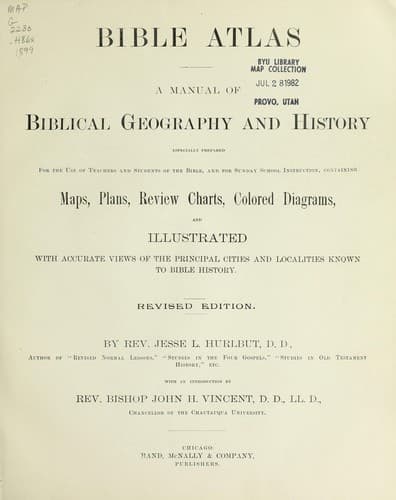
Bible Atlas: A Manual of Biblical Geography and HistoryHurlbut, Jesse Lyman
Religion
Bible Atlas: A Manual of Biblical Geography and History
Hurlbut, Jesse Lyman
Bible -- Geography; Bible -- Geography -- Maps; Bible -- History of Biblical events
2. =The Danite Migration=, related in Judges 17, 18, took place about
the same time. The tribe of Dan was crowded by the Philistines into two
towns, Zorah and Eshtaol. A part of the warriors went upon an expedition
northward, and finding Laish, at one of the sources of the Jordan,
undefended, slew its Zidonian inhabitants, and made it their home and a
sanctuary of idols, under a new name, Dan. This formed the northern
outpost of the land of Israel.
3. =The Civil War.= (Judges 19-21.) This was caused by a crime among the
people of one city, Gibeah, whose part was taken by the entire tribe,
according to the Oriental view of honor among members of a clan. It led
to a war between Benjamin and the rest of the tribes, at the end of
which, by the battle of Gibeah, the one tribe was almost annihilated.
[Illustration: MOUNT TABOR.]
II. THE OPPRESSIONS AND THE JUDGES.
From the times of Joshua to those of Saul, the Israelites were ruled by
men raised up to meet the needs of the hour, not by succession or
appointment, but by personal character and influence. Most of them ruled
over a limited region, and more than one doubtless was in authority at
the same time, in different parts of the land. They were called forth by
a series of _oppressions_, which were sometimes invasions by foreign
tribes, and sometimes the uprising of the native peoples against their
Israelite conquerors, reversing the relation for a time. The judges
were, in most instances, men who led the Israelites in throwing off the
yoke of these foreign races. The oppressions are generally reckoned as
seven, though the third was rather an invasion than an oppression; and
the judges, as fifteen in number, though several were not judges, in the
strict sense of the word.
1. =The Mesopotamian Oppression= (Judges 3:1-11) was the first,
occurring soon after the death of Joshua. It resulted from the conquests
of a king named Chushan-rishathaim, who reigned in Mesopotamia. From the
two facts, that at this period the kings of Edom had Aramean names (Gen.
36), and that the deliverer of Israel was Othniel, of the tribe of
Judah, the first judge, it has been concluded that the region of this
oppression was the territory of that tribe, in the southern portion of
Palestine.
2. =The Moabite Oppression.= (Judges 3:12-30.) The Moabites lived south
of the torrent Arnon, on the east of the Dead Sea. In alliance with the
wandering Ammonites, further eastward, and the Amalekites of the desert,
under their king, Eglon, they took possession of Jericho (which stood as
an unwalled town), and made it the centre of rule over the central
portion of the land, chiefly Benjamin and Judah. Ehud, the second
judge, assassinated Eglon, and then called upon his countrymen to
assemble at Mount Ephraim. A decisive battle was fought at the "Fords of
Moab" (where the Israelites had crossed the Jordan on their first
entrance to the land), resulting in the defeat of the Moabites and the
freedom of Israel.
Public-domain text, read in full here on John Shaqi.
Reviews
Reviews
No reviews yet
Be the first to share your thoughts on this work.
Elsewhere in the archive
Join the Discussion
Join the discussion
Sign in to leave a comment or review.
Sign InorCreate an account