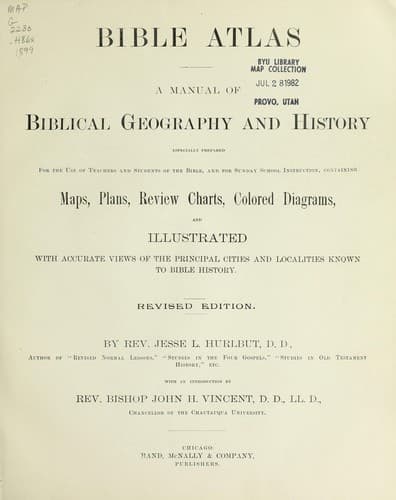
Bible Atlas: A Manual of Biblical Geography and HistoryHurlbut, Jesse Lyman
Religion
Bible Atlas: A Manual of Biblical Geography and History
Hurlbut, Jesse Lyman
Bible -- Geography; Bible -- Geography -- Maps; Bible -- History of Biblical events
3. =The Early Philistine Oppression= (Judges 3:31) was perhaps no more
than a raid of these people upon the mountain region of Judah. It was
repelled by Shamgar, the third judge, whose army of farmers, hastily
gathered, had no other weapons than their formidable ox-goads. The
precise place of the victory is unknown, but it was on the frontier
between Judah and Philistia.
4. =The Canaanite Oppression= (Judges 4, 5) was an uprising of the
native people against the Israelite conquerors. They changed the
relations of the two races, by becoming the dominant people in all the
region north of the Carmel range of mountains. Their capital was at
Hazor, and their chief military post at Harosheth, near the Plain of
Esdraelon. A woman, Deborah, living between Ramah and Bethel, was then
recognized as the fourth judge. She called upon Barak, of Naphtali, who
aided her in gathering a little army, chiefly from the tribes of
Issachar, Zebulon and Naphtali. They met at Mount Tabor, from which they
poured down upon the Canaanites, who were encamped upon the plain. In
the rout that followed, the Israelites were aided by a sudden storm,
and a rise in the torrent Kishon, which swept away many of their
enemies. The power of the Canaanites was broken, and thenceforward the
race made no attempt to regain its independence.
5. =The Midianite Oppression= (Judges 6-8) was the most severe, thus
far, in the history of the judges. The Midianites, a migratory tribe on
the east of Palestine, joined with the Amalekite Bedouins in an invasion
which overran all the central portion of the land, plundering the
inhabitants, and destroying the fruits of the field. So low were the
Israelites reduced, that they were compelled to hide their crops, and
themselves also, in the caves of the mountains. The deliverer of Israel
at this period was Gideon, the fifth judge. At God's call he summoned
his countrymen, and gathered an army on Mount Gilboa, while their
enemies were encamped at the foot of the Hill Moreh (Little Hermon), an
innumerable host. With three hundred chosen men Gideon made a night
attack upon the Midianite host. They were defeated, and fled down the
ravine to the Jordan Valley, past Beth-shean, Abel-meholah and Tabbath.
Beth-barah, where they were intercepted by the men of Ephraim, was not
the same with the Bethabara of the New Testament, but probably in the
Jordan Valley, north of the Jabbok. At Succoth, near the junction of the
Jabbok and the Jordan, and at Penuel, in the valley of the Jabbok, the
pursuing Israelites under Gideon were inhospitably treated by the
inhabitants, but avenged themselves on their return. The remains of the
routed Midianite army were found by Gideon at Karkor, a place not
precisely known. He made a circuit, attacked them on the east, and
utterly destroyed them. After this victory Gideon bore rule over Israel
from his home in Ophrah, until his death.
Public-domain text, read in full here on John Shaqi.
Reviews
Reviews
No reviews yet
Be the first to share your thoughts on this work.
Elsewhere in the archive
Join the Discussion
Join the discussion
Sign in to leave a comment or review.
Sign InorCreate an account