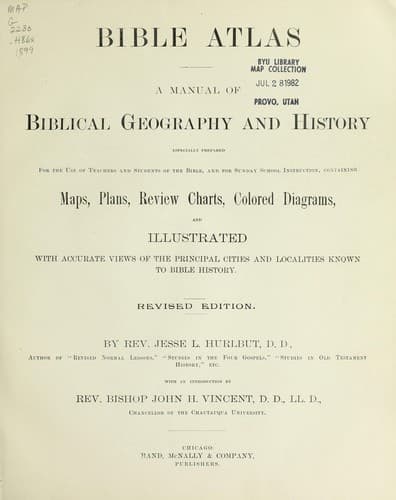
Bible Atlas: A Manual of Biblical Geography and HistoryHurlbut, Jesse Lyman
Religion
Bible Atlas: A Manual of Biblical Geography and History
Hurlbut, Jesse Lyman
Bible -- Geography; Bible -- Geography -- Maps; Bible -- History of Biblical events
After the death of Gideon arose his son Abimelech, the sixth judge, "the
bramble king," who reigned over a small district around Shechem. (Judges
9.) He was not one of the divinely chosen deliverers, and strictly
should not be reckoned in the list of judges. He was slain ignobly at
Thebez, north of Shechem. The seventh judge was Tola, who ruled from
Shamir, in Mount Ephraim. (Judges 10:1, 2.) The eighth was Jair, whose
home was at Camon, in Mount Gilead, east of the Jordan. (Judges 10:3-5.)
6. =The Ammonite Oppression= (Judges 10:6-18; 11:1-40) was perhaps
contemporaneous with the early part of the one named after it, the
Philistine. It embraced the land of the tribes on the east of the
Jordan, and lasted eighteen years. The Israelites rallied at Mizpeh of
Gilead (the place where Jacob and Laban made their covenant, Gen.
31:49), and called to the command Jephthah, the ninth judge, who was
living as a freebooter in the land of Tob, north of Gilead. He marched
against the Ammonites, and fought them at Aroer, on the border of the
torrent Arnon. He drove them in flight northward, and wasted their
territory as far as Minnith, near Heshbon. On his return took place the
fulfillment of his vow upon his daughter (Judges 11:40); and a civil
strife with the haughty tribe of Ephraim (Judges 12:1-6), which attacked
Gilead, but was beaten and put to flight. At the fords of Jordan many
thousand Ephraimites were slain in attempting to cross. Probably this
was the same place referred to already as Beth-barah. (Judges 7:24.)
After Jephthah, the tenth judge was Ibzan of Bethlehem, north of Mount
Carmel; the eleventh, Elon of Aijalon, in the tribe of Zebulon; the
twelfth, Abdon of Pirathon, in Ephraim. (Judges 12:8-15.)
7. =The Philistine Oppression= (Judges 13-16) began about the same time
with the Ammonite, but lasted far longer. During all the judgeships of
Eli, the thirteenth judge, of Samson the fourteenth, of Samuel the
fifteenth and last, and the forty years of Saul's reign, Israel remained
more or less under Philistine domination. In the reign of Saul we read
of Philistine garrisons throughout the land, as at Bethel (1 Sam.
10:3-5) and at Geba (1 Sam. 13:3), and not until all Israel was
consolidated under the strong sceptre of David, was the Philistine yoke
entirely thrown off.
Eli, the thirteenth judge, was also high-priest, and ruled from Shiloh,
the place of the ark. The history relates only the events at the close
of his judgeship, when, by the loss of the ark at Ebenezer, and the
death of Eli, on the same day, the Israelites were reduced to the lowest
condition of trouble.
Public-domain text, read in full here on John Shaqi.
Reviews
Reviews
No reviews yet
Be the first to share your thoughts on this work.
Elsewhere in the archive
Join the Discussion
Join the discussion
Sign in to leave a comment or review.
Sign InorCreate an account