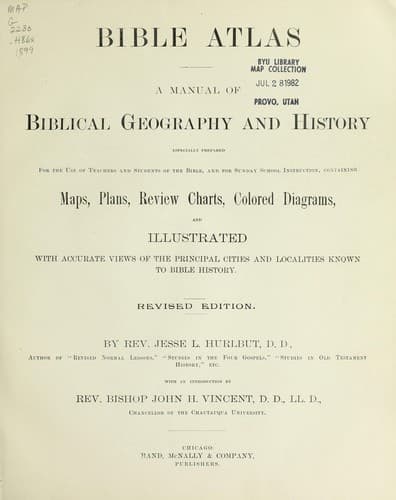
Bible Atlas: A Manual of Biblical Geography and HistoryHurlbut, Jesse Lyman
Religion
Bible Atlas: A Manual of Biblical Geography and History
Hurlbut, Jesse Lyman
Bible -- Geography; Bible -- Geography -- Maps; Bible -- History of Biblical events
I. =Saul's Appointment as King.= (1 Sam. 9-12.) This is connected with
four places. Ramah, the residence of Samuel (probably _Neby Samwil_,
3-1/2 miles nearly north of Jerusalem), where Saul was privately
crowned; Mizpeh, an unknown place, near by, and also north of Jerusalem,
where he was introduced to the people as king; Gibeah (_Tuleil el Ful_,
4 miles north of Jerusalem), his home and capital; and Gilgal, in the
Jordan Valley, where he was formally recognized as king, after his
victory at Jabesh-gilead. The places named in the account of Saul's
search for his father's stray asses, which led him to Samuel, are not
known with certainty; but Shalisha may be _Sirisia_, 13 miles north of
Lydda, and Zuph may be another name for Zophim, or Ramah, of which the
name in full was Ramathaim-zophim.
II. =The Wars of Saul.= (1 Sam. 11-18.) These were as follows:
1. _The Ammonite War._ (1 Sam. 11.) The Ammonites were a roving,
predatory, cruel people, ancient enemies of Israel, living east of the
Moabites. Under their king, Nahash, they invaded the territory east of
the Jordan, and besieged Jabesh-gilead (_ed Deir_). Word came to Saul,
who instantly summoned the warriors of Israel. They met at Bezek (not
the same with the Bezek of Judges 1:4, but probably the ruin _Ibzik_, a
little north of Tirzah), marched against the Ammonites, and, under
Saul's vigorous leadership, utterly discomfited them. The relief of
Jabesh-gilead, Saul's first victory, greatly strengthened his authority
as king, over the tribes.
2. _The First Philistine War._ (1 Sam. 13, 14.) At the time of Saul's
accession, the Philistine outposts held Geba, Bethel, and other places
in the mountain region. Saul undertook to free the land, and summoned
the Israelites, who came tremblingly, being thoroughly cowed under their
oppressors. Saul's son Jonathan struck the first blow, by attacking the
Philistines at Geba (_Jeba_), near Gibeah, Saul's capital; and soon
followed it up by a great victory at Michmash, across the valley from
Geba. The Israelites now gained courage, and pursued the Philistines,
even to their own borders. Nevertheless, the Philistines continued to
hold their fortresses in Israel through all the reign of Saul, and wars
were constant between the two races.
Three other wars of Saul are named in a single verse (1 Sam. 14:47),
without mention of particular events. These are as follows:
3. _The Moabite War._ These people lived south of the brook Arnon, and
east of the Dead Sea. The war with them may have taken place in
connection with the Ammonite campaign, already referred to. No
battle-fields are named, so that the places of the war cannot be given.
It resulted in the defeat of the Moabites, but not in their subjection
to Israel.
Public-domain text, read in full here on John Shaqi.
Reviews
Reviews
No reviews yet
Be the first to share your thoughts on this work.
Elsewhere in the archive
Join the Discussion
Join the discussion
Sign in to leave a comment or review.
Sign InorCreate an account