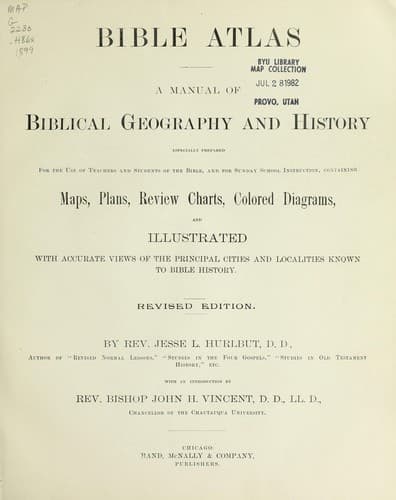
Bible Atlas: A Manual of Biblical Geography and HistoryHurlbut, Jesse Lyman
Religion
Bible Atlas: A Manual of Biblical Geography and History
Hurlbut, Jesse Lyman
Bible -- Geography; Bible -- Geography -- Maps; Bible -- History of Biblical events
Upon the map the following are indicated: 1. The portions of the land
under Philistine and Canaanite control are given in yellow, while the
territory governed by Saul is shown in pink. The mountain region was
held by Israel, and the lowlands, both by the sea and the Jordan, by the
Philistines. 2. The names of Philistine cities are printed in red. Some
of these were their own hereditary possessions; others (as Aphek, Geba
and Bethel) were fortresses in the mountain region, garrisoned to hold
Israel in subjection. 3. The battle-fields and wars of Saul are
indicated by flags, and numbered. (1.) Jabesh-gilead, over the
Ammonites. (1 Sam. 11.) (2.) Michmash, over the Philistines. (1 Sam.
14.) (3.) In Moab, at some unknown place. (1 Sam. 14:47.) (4.) In Edom,
at a place also unknown. (1 Sam. 14:47.) (5.) Over the Syrians of Zobah.
(1 Sam. 14:47.) This we have indicated as taking place in the half tribe
of Manasseh, East; but its precise location is unknown. (6.) "A city of
Amalek," place unknown. (1 Sam. 15:5.) (7.) Valley of Elah, over the
Philistines. (1 Sam. 17:2.) (8.) Mount Gilboa. (1 Sam. 31.) 4. The
various places named in Saul's pursuit of David are shown upon the map,
with their most probable identifications. These places are: (1.) Gibeah.
(2.) Ramah. (3.) Gibeah. (4.) Nob. (5.) Gath. (6.) Adullam. (7.) Mizpeh
of Moab. (8.) Hareth. (9.) Keilah. (10.) Ziph. (11.) Maon. (12.)
En-gedi. (13.) Maon. (14.) Gath. (15.) Ziklag. (16.) Hebron.
OUTLINE FOR REVIEW.
I. _Saul's Appointment._ Ramah, Gibeah, Gilgal, Shalisha, Zuph.
II. _Wars of Saul._ 1. Ammonite. (Jabesh-gilead, Bezek.) 2. First
Philistine. (Geba, Michmash.) 3. Moabite. 4. Edomite. 5. Syrian. 6.
Amalekite. (Telaim, Gilgal.) 7. Second Philistine. (Valley of Elah.)
III. _Pursuit of David._ 1. Gibeah. 2. Ramah. 3. Gibeah. 4. Nob. 5.
Gath. 6. Adullam. 7. Mizpeh of Moab. 8. Hareth. 9. Keilah. 10. Ziph. 11.
Maon. 12. En-gedi. 13. Maon. 14. Gath. 15. Ziklag. 16. Hebron.
IV. _Saul's Death._ Aphek, Gilboa, Beth-shean, Jabesh-gilead.
[Illustration: JERICHO.]
[Illustration: THE EMPIRE OF DAVID AND SOLOMON.]
THE EMPIRE OF DAVID AND SOLOMON.
[Illustration: TOWER OF DAVID.]
THE greatness of David may be shown by a comparison of our last map with
the present one, keeping in mind the difference of scale between them.
David succeeded to the throne of Israel when it represented about 6,000
square miles of territory, more or less, under control; he left to his
successor, Solomon, an empire embracing an area of 60,000 square miles.
See the comparative diagram on page 70. The map now before us being upon
a scale greatly reduced from that of Saul's kingdom, it will be
impossible to represent upon it all the localities mentioned in the
history of David and Solomon. Those in the neighborhood of Jerusalem
will be found on the map of the Environs of Jerusalem, page 83, and
those of minor importance in the land of Israel may be found on the map
of Palestine Among the Tribes, page 58.
Public-domain text, read in full here on John Shaqi.
Reviews
Reviews
No reviews yet
Be the first to share your thoughts on this work.
Elsewhere in the archive
Join the Discussion
Join the discussion
Sign in to leave a comment or review.
Sign InorCreate an account