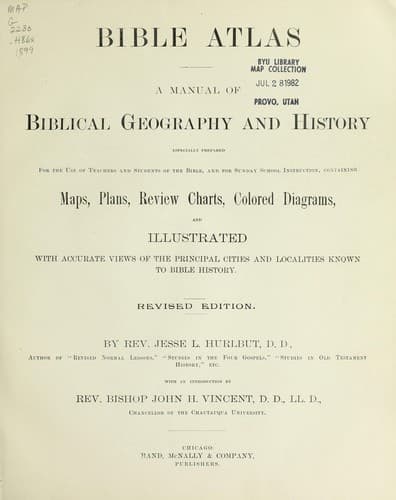
Bible Atlas: A Manual of Biblical Geography and HistoryHurlbut, Jesse Lyman
Religion
Bible Atlas: A Manual of Biblical Geography and History
Hurlbut, Jesse Lyman
Bible -- Geography; Bible -- Geography -- Maps; Bible -- History of Biblical events
We present the events and localities under the following outline: 1.
David's Reign over Judah. 2. The Union of Palestine. 3. David's Foreign
Conquests. 4. David's Calamities. 5. The Closing Events. 6. The Reign of
Solomon.
I. =David's Reign over Judah.= (2 Sam. 1-4.) After the death of Saul,
David went from Ziklag to Hebron, and was there accepted as king over
the tribe of Judah. His reign lasted for seven years, from 1010 to 1003
B.C. During a part of this time, Ishbosheth, the only remaining son of
Saul, was also nominally reigning over a large part of the land, the
real power being held by Abner, Saul's general, and the ablest man of
his time. War naturally arose, and many battles were doubtless fought,
of which but one, at Gibeon, is related. At last, Abner and Ishbosheth
were both murdered, though not by David's desire nor with his
approbation; and, with one consent, David was accepted as king over all
the Twelve Tribes.
II. =The Union of Palestine.= (2 Sam. 5-7.) David was now ruler over the
mountain region only, as Saul had been before him, and in various places
were garrisons of the Philistines, and cities held by the Canaanite
races. He began by a siege of Jebus, or Jebusi, a fortress of the
Jebusites, on the border of Judah and Benjamin. Though deemed
impregnable by the natives, it was taken by storm, and, under its new
name, JERUSALEM, became the capital of the kingdom. The Philistines had
been friendly with David in the past, and were perhaps recognized as the
"lords paramount" during his reign over Judah; but now they were jealous
of his growing power, and, as of old, entered the mountain region with
their armies. But in David they met an enemy of a different character
from either Samson or Saul. Two battles were fought, both near
Jerusalem, at a place called "the Valley [or plain] of the Rephaim"; and
in each the Philistines were utterly routed.
David followed up his advantage, after the second victory, by marching
down upon the Shefelah and the plain. He took Gath (called Methegammah,
"the bridle of the metropolis," in 2 Sam. 8:1), and subjugated the
entire Philistine confederacy so completely that thenceforward they
ceased to trouble Israel for centuries.
The land was now united, and David turned his attention to the religious
reformation of the people, brought the ark from Baale, or
Kirjath-jearim, to Jerusalem, planned for the Temple to be built by his
successor, and organized the worship on a magnificent scale. (2 Sam. 6,
7.)
III. =David's Foreign Conquests.= These were not altogether inspired by
ambition, but were necessary for the safety of Israel, and to keep its
people from the contamination of the idolatry of the surrounding
nations. These conquests are indicated by flags on the map, though the
precise locations of the battles are not known in all cases. The lands
conquered by David were as follows:
Public-domain text, read in full here on John Shaqi.
Reviews
Reviews
No reviews yet
Be the first to share your thoughts on this work.
Elsewhere in the archive
Join the Discussion
Join the discussion
Sign in to leave a comment or review.
Sign InorCreate an account