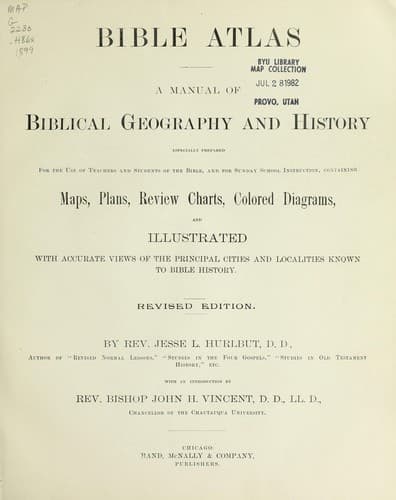
Bible Atlas: A Manual of Biblical Geography and HistoryHurlbut, Jesse Lyman
Religion
Bible Atlas: A Manual of Biblical Geography and History
Hurlbut, Jesse Lyman
Bible -- Geography; Bible -- Geography -- Maps; Bible -- History of Biblical events
1. _Moab._ (2 Sam. 8:2.) It is stated by Josephus, that the cruel
treatment of the Moabites (though fully in accord with the customs of
Oriental war in that day) was in revenge for the slaughter of David's
parents by the king of Moab, an event not mentioned in the Bible.
2. _Zobah_ (2 Sam. 8:3, 4), at that time the principal state between
Damascus and the Euphrates.
3. _Damascus_ (2 Sam. 8:5-12), in alliance with Zobah, and the largest
city in Syria.
4. _Edom_ (2 Sam. 8:13, 14), south of the Dead Sea. The word "Syrians,"
in verse 13, should undoubtedly be "Edomites." The battle was fought at
the "valley of salt," an unknown place, but probably near Sela, or
Petra, the capital of Edom.
5. _Ammon._ (2 Sam. 10-13.) This was the longest of David's wars, and
was waged not against the Ammonites only, but against the allied forces
of several small Syrian kingdoms, as Zobah (already conquered, but not
subjugated), Maachah, Rehob and Tob, districts on the north and east of
Israel. Three great battles were fought; the first near Medeba; the
second at Helam, an uncertain locality (if it be the name of a place,
which is questioned, as the word means "host," or "army"); and the
third, the siege and capture of Rabbah, the capital of the Ammonites,
which ended the war. During this war occurred the crime of David with
Bathsheba, and the murder of Uriah. (2 Sam. 11.) This completed the
series of conquests, and made the throne of David supreme from the Red
Sea to the Euphrates. One fact which made these conquests possible was
that the tribes around Israel were not united into strong nations, as
afterward in the cases of Syria and Assyria, but were independent
principalities, easily overcome in turn by the trained warriors of
David.
As a result of these wars the kingdom of David, which he transmitted to
his son Solomon, was the largest in the Oriental world at that time. The
Assyrian empire had not arisen, the great kings of Egypt had passed
away, and the East was broken up into small principalities, among which
Israel easily rose to power.
COMPARATIVE AREA OF PALESTINE
AT DIFFERENT PERIODS.
Public-domain text, read in full here on John Shaqi.
Reviews
Reviews
No reviews yet
Be the first to share your thoughts on this work.
Elsewhere in the archive
Join the Discussion
Join the discussion
Sign in to leave a comment or review.
Sign InorCreate an account