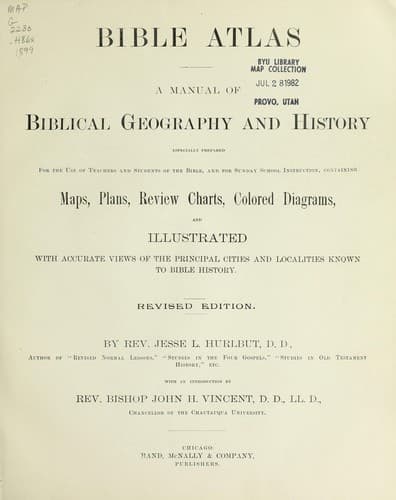
Bible Atlas: A Manual of Biblical Geography and HistoryHurlbut, Jesse Lyman
Religion
Bible Atlas: A Manual of Biblical Geography and History
Hurlbut, Jesse Lyman
Bible -- Geography; Bible -- Geography -- Maps; Bible -- History of Biblical events
VI. =Walls.= Of these, three are named by the early historians and
mentioned in the Bible. 1. The first wall was built by David and
Solomon, and surrounded what was known as "the city of David." It
included Zion, Moriah, Ophel, and the southern portion of the Tyropoeon
Valley. The lines of this wall may still be traced and the ancient
foundations shown in various places. 2. The second wall, including Acra,
extended in a curved line from the tower Antonia, north of the Temple,
to a point not yet marked with certainty, on the northern border of
Mount Zion. The location of Calvary and the place of the Saviour's
burial depend upon the question, whether this wall ran outside or inside
of the place where now stands the Church of the Holy Sepulchre. For, as
these were "outside the gate," if the wall include the traditional
localities, they are wrongly located, and the true places must be sought
elsewhere, perhaps near the so-called Grotto of Jeremiah, north of the
city. We indicate both localities, but regard the northern as
preferable. 3. The third wall was not built until after the time of
Christ, but was begun by Herod Agrippa, and was completed not long
before the Roman siege. This section was called "the new city," and
included Mount Bezetha, and the region north and northwest of Mount
Zion. Only a small portion of the wall can be located with certainty.
VII. =History of Jerusalem.= This may be briefly noticed under seven
periods.
1. _The Patriarchal Period_ (B.C. 2000-1300). The earliest mention of
Jerusalem is that in Gen. 14:18, which, taken with Psa. 76:2, seems to
indicate the place, though the identity is questioned by some scholars.
In the time of Abraham, B.C. 1918, according to the common chronology,
Jerusalem was the seat of a kingdom under the priest Melchizedek, who
received homage and tithes, as God's representative, from the patriarch.
At that time it was a centre, not only of political power, but of a
religious worship which was recognized by Abraham as divine and
spiritual.
Public-domain text, read in full here on John Shaqi.
Reviews
Reviews
No reviews yet
Be the first to share your thoughts on this work.
Elsewhere in the archive
Join the Discussion
Join the discussion
Sign in to leave a comment or review.
Sign InorCreate an account