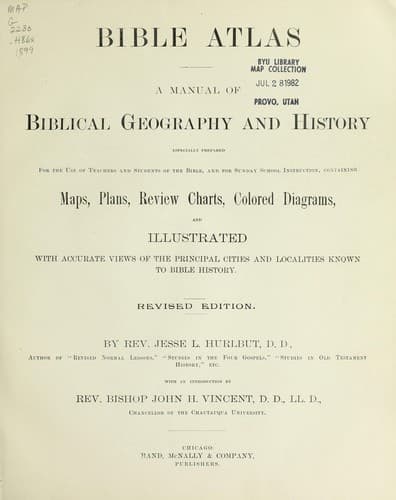
Bible Atlas: A Manual of Biblical Geography and HistoryHurlbut, Jesse Lyman
Religion
Bible Atlas: A Manual of Biblical Geography and History
Hurlbut, Jesse Lyman
Bible -- Geography; Bible -- Geography -- Maps; Bible -- History of Biblical events
2. _The Jebusite Period_ (B.C. 1300-1003). The next reference to
Jerusalem (and the earliest certain account) is at the time of the
conquest, B.C. 1210. At that period it was held by the Jebusites, a
race of Canaanite origin, small in numbers, but of indomitable courage
and resolution, since they were able to hold their city for four
centuries against all the power of Israel. Their king, Adoni-zedek
(Josh. 10:1), may have been a descendant of the pious Melchi-zedek, as
the names are similar; but the ancient purity of the people's worship
had been lost in the idolatry of the surrounding races. The little city
of Jebus, as it was then called, formed a confederation with the other
clans of the south to resist Joshua's invading host. But in the decisive
battle of Beth-horon the Canaanites were routed, their five kings were
slain (among them the king of Jerusalem), and the alliance was broken
up. For the present, Jerusalem was not attacked, but its territory was
assigned to the tribe of Benjamin. (Josh. 18:28.) Soon after the death
of Joshua, however, it was besieged by the united tribes of Judah and
Simeon, as dangerous to the northern frontier of the former. From Judges
1:8, and the history of Josephus, we learn that the lower city (perhaps
on Acra) was taken and burned; but the fortress was found impregnable
"by reason of its walls and also of the nature of the place."
(Josephus.) The city was soon rebuilt (Judges 19:11), and remained in
Jebusite hands through all the age of the Judges and the reign of Saul.
Public-domain text, read in full here on John Shaqi.
Reviews
Reviews
No reviews yet
Be the first to share your thoughts on this work.
Elsewhere in the archive
Join the Discussion
Join the discussion
Sign in to leave a comment or review.
Sign InorCreate an account