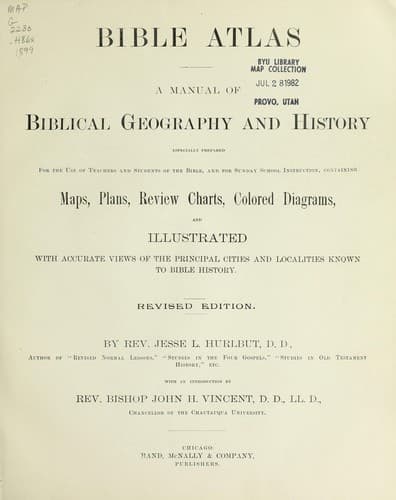
Bible Atlas: A Manual of Biblical Geography and HistoryHurlbut, Jesse Lyman
Religion
Bible Atlas: A Manual of Biblical Geography and History
Hurlbut, Jesse Lyman
Bible -- Geography; Bible -- Geography -- Maps; Bible -- History of Biblical events
3. _The Royal Period_ (B.C. 1003-587). With the accession of David a new
era began in Israel, and every part of the kingdom soon felt the strong
hand of its new master. He was not one to brook a foreign fortress in
the centre of his realm, and in the first year of his reign over united
Israel he marched against it, and demanded its surrender. Trusting to
their strong situation, the Jebusites refused, and, as an insult, placed
"the blind and the lame" on its walls in mockery of his attempt. But,
under the valiant Joab, the height was scaled, the fortress was taken,
and Jerusalem was thenceforth "the city of David." (2 Sam. 5.) David
made it his capital, brought thither the ark of the covenant, and
surrounded it with a new wall. Solomon enriched it with treasures, and
with its greatest glory, the Temple on Mount Moriah. After the division
it remained the capital of Judah, though close to the border of the Ten
Tribes. It was taken without resistance from Rehoboam, by Shishak, the
king of Egypt, and robbed of its wealth, 930 B.C. In the reign of
Jehoshaphat it was restored to something like its former prosperity; but
under his son Jehoram, B.C. 840, it was taken by a sudden attack of the
Philistines and Arabians, and again plundered. Under Athaliah it became
a shrine of abominable Baal worship, but was reformed by Jehoiada in the
earlier days of the reign of Joash. Joash, however, in his later years
allowed the people to relapse into idolatry, with the usual result; for,
about B.C. 800, the powerful Hazael, king of Syria, overran the
Shefelah, defeated the Judaites, and was only kept from entering the
city by a gift of its treasures. Amaziah, the next king, elated by a
victory, offered battle at Beth-shemesh to Joash, king of Israel, then
the most powerful state between Egypt and Assyria. He was defeated; and,
as a result, Jerusalem was entered by the Israelites, its wall was
thrown down, and it was again plundered. The city suffered during the
wicked reign of Ahaz, but was restored and divinely protected from its
Assyrian besiegers in the good reign of Hezekiah. After the death of
Josiah it was entered by the Egyptians under Necho; but its final
destruction was wrought by Nebuchadnezzar, of the Babylonian empire.
Twice he visited it with a heavy hand, setting up one king after
another; and, when his vassal Zedekiah again rebelled, he besieged it
for more than a year, with some intermissions, and at last, in B.C. 587,
made a breach in its walls and took it by storm. Then, for the first
time, the city was absolutely destroyed, and made a heap of ruins, while
its people were carried into captivity.
[Illustration: NATURAL FEATURES OF JERUSALEM.]
Public-domain text, read in full here on John Shaqi.
Reviews
Reviews
No reviews yet
Be the first to share your thoughts on this work.
Elsewhere in the archive
Join the Discussion
Join the discussion
Sign in to leave a comment or review.
Sign InorCreate an account