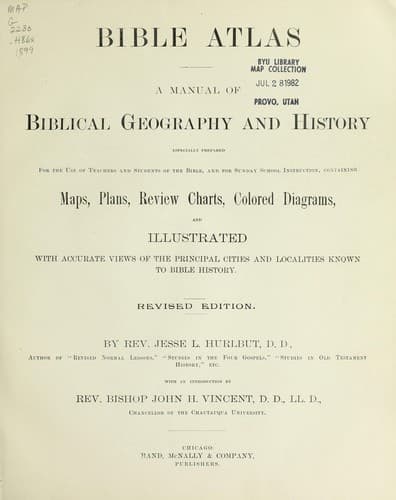
Bible Atlas: A Manual of Biblical Geography and HistoryHurlbut, Jesse Lyman
Religion
Bible Atlas: A Manual of Biblical Geography and History
Hurlbut, Jesse Lyman
Bible -- Geography; Bible -- Geography -- Maps; Bible -- History of Biblical events
5. _The Roman Period_ (A.D. 70-637). For fifty years after its
destruction Jerusalem is not mentioned, and probably remained
uninhabited. But, after the attempt of the false Messiah Bar-cocheba to
rebuild the city and Temple, and restore the independence of the
Jews,--an attempt which was only quelled by calling forth all the power
of the empire,--the emperor Hadrian resolved to establish a heathen city
upon its site. He named it Ælia Capitolina, built on Moriah a temple to
Jupiter, and allowed no Jews to enter the walls, a prohibition which
remained until the empire became Christian. Constantine, the first
Christian emperor, restored the ancient name; and his mother, Helena,
made a pilgrimage to the city, A.D. 326, which now began to be regarded
as a sacred place by Christians. At this time the first Church of the
Holy Sepulchre was built, over the place where Helena discovered the
tomb of Jesus. The emperor Julian, A.D. 362, out of hatred to the
Christians, undertook to rebuild the Temple, and make it once more a
Jewish centre; but was defeated in his plans by earthquakes and the
leaping forth of subterranean fires, as is related by Ammianus
Marcellinus, himself a heathen, the friend and companion in arms of the
emperor. He states: "Horrible balls of fire, breaking out near the
foundations, with frequent and reiterated attacks, rendered the place
from time to time inaccessible to the scorched and blasted workmen; and,
the victorious element continuing in this, obstinately and resolutely
bent, as it were, to drive them to a distance, the undertaking was
abandoned." In 529 A.D. the emperor Justinian founded a church upon the
site where now is the Mosque el Aksa, and a tide of pilgrims, increasing
with each generation, began to pour upon the holy places. In 614 A.D.
the city was taken by the Persian king, Chosroes II., the churches were
destroyed, and multitudes of priests and monks were slain; but 14 years
afterward it was retaken by the emperor Heraclius, and held, though but
for a short time, by the Christians.
6. _The Mediæval Period_ (A.D. 637-1517). In 637 Palestine and Jerusalem
passed under the dominion of the Moslems, then ruled by the Caliph Omar;
but the holy places were respected, and the Christians were allowed to
retain their churches. Under the Fatimite caliphs of Cairo the
Christians were persecuted, and the Church of the Holy Sepulchre was
several times destroyed and rebuilt. The pilgrims from Europe brought
trade and tribute, so that the city flourished, in spite of frequent
pillagings and captures by various Arab and Turkish hordes. On July 15,
1099, it was taken by the Crusaders, after a terrible assault, and for
88 years was the seat of a Christian kingdom. Saladin reconquered it in
1187; and various changes in its government and several sieges followed,
until 1517, when it finally passed under the rule of the Turks, who have
since been its masters.
Public-domain text, read in full here on John Shaqi.
Reviews
Reviews
No reviews yet
Be the first to share your thoughts on this work.
Elsewhere in the archive
Join the Discussion
Join the discussion
Sign in to leave a comment or review.
Sign InorCreate an account