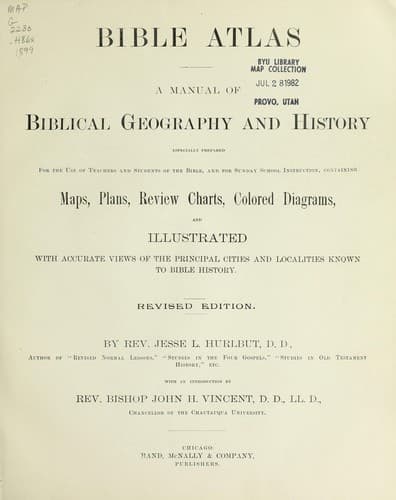
Bible Atlas: A Manual of Biblical Geography and HistoryHurlbut, Jesse Lyman
Religion
Bible Atlas: A Manual of Biblical Geography and History
Hurlbut, Jesse Lyman
Bible -- Geography; Bible -- Geography -- Maps; Bible -- History of Biblical events
III. =Gates.= Of these there are seven, two of which are closed. 1. The
Jaffa or Yafa Gate, called by Moslems, _Bab el Khalil_, "Hebron Gate,"
is in the western wall, near the Citadel of David. Through this gate
most travelers enter the city. 2. The Damascus Gate (_Bab el Amud_,
"Gate of the Column,") is in the middle of the northern wall (right of
the picture), and leads to the northward road, over Scopus, past the
(so-called) Tombs of the Kings, to Samaria and Damascus. 3. The Gate of
Herod (_Bab es Zahireh_) is in the northern wall (right of the picture),
but is kept closed during most of the year. 4. The Gate of St. Stephen
(_Bab es Sitti Mariam_, "Gate of our Lady Mary,") is in the eastern wall
(foreground of the picture), and is supposed by some to be the place of
Stephen's martyrdom. The road leads from it past the Garden of
Gethsemane, over Mount Olivet, and through Bethany. 5. The Golden Gate,
walled up, is in the eastern wall, and is shown in the picture in front
of the Dome of the Rock. Its Moslem names are _Bab el Taubeh_, "Gate of
Repentance," and _Bab ed Dahariyeh_, "Eternal Gate." 6. The Dung Gate,
called also the Moorish Gate (_Bab ed Mugharibeh_), is a small portal in
the southern wall, leading to the village of Siloam, but usually closed.
It is shown on the left of the picture. 7. The Zion Gate (_Bab en Neby
Daud_, "Gate of the Prophet David,") is in the southern wall, opening on
Mount Zion, indicated on the picture in the background on the left.
IV. =Quarters.= These are four in number, given to the different
religions; but to them may be added the Temple Enclosure, which forms a
separate section of the city. Their boundaries cannot be traced upon the
picture, but may be seen on the map of Modern Jerusalem, page 81. Two
important streets, crossing each other nearly at right angles, divide
the city into the four unequal sections called quarters. The streets are
David Street, running eastward from the Jaffa (Yafa) Gate, and Damascus
Street, southward from the Damascus Gate; though both have different
names in some places.
1. The Mohammedan Quarter occupies the northeastern half of the city,
and is the foreground of our view. Its principal objects of interest
are, the Church of St. Mary Magdalene, the Church of St. Anne, two
convents, two mosques, a building known as Pilate's Hall, and the narrow
and crooked street known as the Via Dolorosa, "The Sorrowful Way,"
through which Christ is (traditionally) said to have carried his cross;
a street crowded with places commemorating different events in the
passion of our Lord.
Public-domain text, read in full here on John Shaqi.
Reviews
Reviews
No reviews yet
Be the first to share your thoughts on this work.
Elsewhere in the archive
Join the Discussion
Join the discussion
Sign in to leave a comment or review.
Sign InorCreate an account