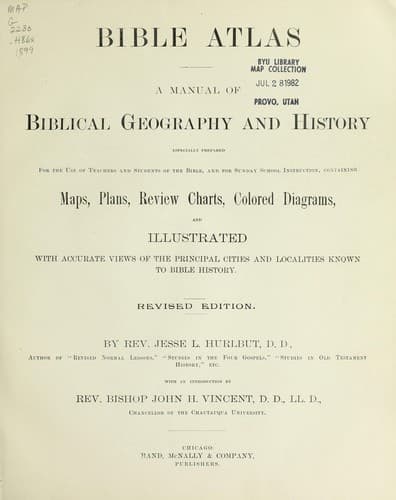
Bible Atlas: A Manual of Biblical Geography and HistoryHurlbut, Jesse Lyman
Religion
Bible Atlas: A Manual of Biblical Geography and History
Hurlbut, Jesse Lyman
Bible -- Geography; Bible -- Geography -- Maps; Bible -- History of Biblical events
3. Five miles beyond Gibeon is _Beth-horon_, celebrated as the place
where was fought the great battle of the conquest, which, measured by
its results, was the most important battle in the history of the world,
since upon it was staked the world's religion. If ever the sun might
stand still, it was then, when earth's destiny was in the balance.
(Josh. 10:9-14.) The "upper Beth-horon" is at _Beit ur el Foka_, and the
lower at _Beit ur et Tahta_, two miles beyond it.
In this brief view we have compassed the most important places upon the
map within 15 miles around the city of Jerusalem.
OUTLINE FOR TEACHING AND REVIEW.
SUGGESTIONS FOR TEACHING.
1. Locate upon the blackboard Jerusalem as a centre, and in presence of
the class draw the general direction of the roads leading from it. It is
scarcely necessary to draw the valleys and mountains, as they are but
rarely referred to by name. The teacher may mark the line of the road in
French chalk or common slate-pencil upon the blackboard, in advance of
the lesson, making a faint line, which can be followed with the crayon
afterward.
2. Then take each road in order, going out from Jerusalem, and indicate
the places near it, stating the events of Bible History in connection
with each place.
3. It would be a good plan to write on slips of paper the references to
texts, distribute them among the class, and have each text read by a
student as its event is named.
REVIEW.
I. _Northern Road._ 1. Scopus. (Titus.) 2. Nob. (Slaughter of priests.)
3. Gibeah. (Saul's court.) 4. Anathoth. (Jeremiah.) 5. Ramah.(?)
(Samuel.) 6. Michmash. (Jonathan's exploit.) 7. Ai. (Achan.) 8. Beeroth.
(Gibeonites; Jesus lost in Temple.) 9. Bethel. (Jacob's ladder.) 10.
Rimmon. (Benjamin.) 11. Ephraim. (Christ's retirement.)
II. _Eastern Road._ 1. Bethany. (Lazarus.) 2. Steep descent. 3. Jericho.
III. _Southern Road._ 1. Plain of Rephaim. (David's victory.) 2.
Rachel's Tomb. 3. Bethlehem. (David, Jesus.) 4. Valley of Elah. (David
and Goliath.) 5. Hebron. (Abraham's sepulchre.) 6. Jeshimon
(Wilderness).
IV. _Southwestern Road._ "Jerusalem to Gaza." (Philip.)
V. _Western Road._ 1. Emmaus. (Risen Christ.) 2. Kirjath-jearim.
(Removal of ark.)
VI. _Northwestern Road._ 1. Mizpeh. (Samuel.) 2. Gibeon. (Solomon's
choice.) 3. Beth-horon. (Joshua's victory.)
[Illustration: GETHSEMANE.]
[Illustration: THE DIVISION OF SOLOMON'S EMPIRE.]
THE DIVISION OF SOLOMON'S EMPIRE.
ON the death of Solomon, B.C. 935, the empire which had been won by the
sword and consolidated by the statesmanship of David, fell asunder, and
five kingdoms took the place of one. These were:
1. The portion of Solomon's empire north of Mount Hermon and extending
to the Euphrates revolted, and formed the =Kingdom of Syria=, having
Damascus for its capital. This kingdom, at first small, soon rose to
power, and at its height, under Hazael, was the leading nation in Asia,
west of the Euphrates. It fell, about B.C. 750, under the power of
Assyria.
Public-domain text, read in full here on John Shaqi.
Reviews
Reviews
No reviews yet
Be the first to share your thoughts on this work.
Elsewhere in the archive
Join the Discussion
Join the discussion
Sign in to leave a comment or review.
Sign InorCreate an account