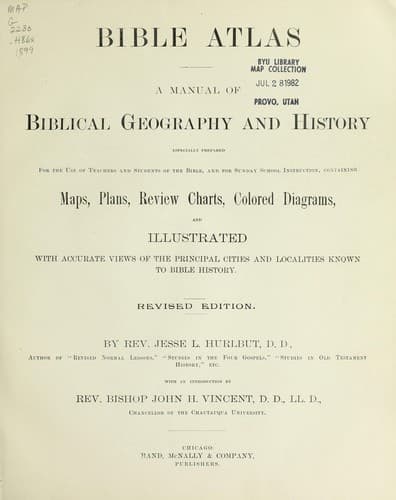
Bible Atlas: A Manual of Biblical Geography and HistoryHurlbut, Jesse Lyman
Religion
Bible Atlas: A Manual of Biblical Geography and History
Hurlbut, Jesse Lyman
Bible -- Geography; Bible -- Geography -- Maps; Bible -- History of Biblical events
[Illustration: CHRONOLOGICAL CHART OF KINGS OF ISRAEL AND JUDAH.]
2. South of Syria was the =Kingdom of Israel=, or the Ten Tribes,
founded by Jeroboam, B.C. 935, soon after the death of Solomon. This
included by far the larger portion of Palestine Proper, having 9,400
square miles, while the rival kingdom of Judah had but 3,400. It
received the allegiance of all the tribes on the east of the Jordan. The
boundary line between the two kingdoms ran south of Jericho, Bethel and
Joppa. This line was, however, very variable, being moved northward or
southward, according to the relative power of the kingdoms. Over this
kingdom reigned nineteen kings, representing several dynasties, with
intervals of anarchy and frequent change. Its capital was at first
Shechem, then Tirzah, until Omri, the founder of the third dynasty,
chose a permanent location at SAMARIA, which soon became to Israel all
that Jerusalem was to Judah, and in time gave its name to the entire
province. Its two religious sanctuaries were at Dan on the north, and at
Bethel on the south, where the national worship to Jehovah, was
maintained under the form of a calf or young ox.
3. =The Kingdom of Judah= included the tribe of that name, a portion of
Benjamin, and perhaps of Simeon also, though the southern boundary was
always uncertain. The Shefelah, or low hills, and the sea-coast, were
probably controlled by the Philistines, though nominally belonging to
Judah. This kingdom remained loyal to the house of David during all its
history, and was ruled by twenty-one kings, all of one family. It was
destroyed by Nebuchadnezzar, B.C. 587.
4. =Moab= lay east of the Dead Sea, between the brooks Arnon and Zered.
It was nominally subject to Israel (the northern kingdom); but, from the
indications of the history and of the Moabite Stone (a monument of
Mesha, the king of Moab, erected in the time of Elisha the prophet), it
may be inferred that it had its own government, and only occasionally
paid tribute to the Ten Tribes. Strong kings, like Omri, Ahab and
Jeroboam II., may have held power over it; but during most of the time
it was practically independent.
5. =Edom=, south of the Dead Sea, had been conquered by David, and
remained subject during the reign of Solomon. After the disruption it
held to Judah about the same relation that Moab held to Israel,
dependent and tributary, but not annexed as a part of the realm. There
was a king of Edom during the reign of Jehoshaphat (2 Kings 3:9), but
evidently subject to Judah. The Edomites finally gained their
independence during the reign of Jehoram, the son of Jehoshaphat (2
Kings 8:16-22), despite a defeat which they suffered at Zair (probably
Seir, or Sela). Like all the kingdoms around it, this kingdom fell under
the rule of Nebuchadnezzar.
Public-domain text, read in full here on John Shaqi.
Reviews
Reviews
No reviews yet
Be the first to share your thoughts on this work.
Elsewhere in the archive
Join the Discussion
Join the discussion
Sign in to leave a comment or review.
Sign InorCreate an account