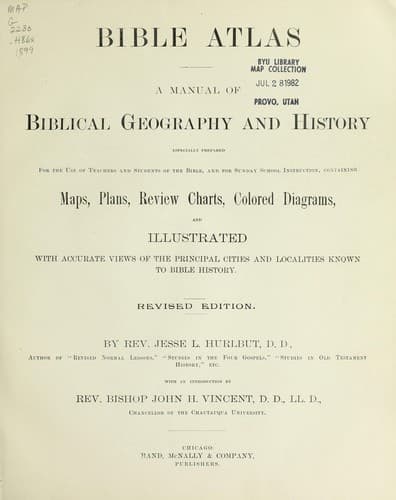
Bible Atlas: A Manual of Biblical Geography and HistoryHurlbut, Jesse Lyman
Religion
Bible Atlas: A Manual of Biblical Geography and History
Hurlbut, Jesse Lyman
Bible -- Geography; Bible -- Geography -- Maps; Bible -- History of Biblical events
[Illustration: BABYLON.]
PERIOD OF RESTORATION 536 B.C.-70 A.D.
The closing portion of Old Testament history, from the edict of Cyrus
the Great, B.C. 536, permitting the captive Jews to return to Palestine,
is known as the Period of Restoration. From that time until the end of
the Jewish history, the land was under foreign rule. The Period of
Restoration, from the return from captivity to the birth of Christ, may
be divided as follows:
1. =The Persian Supremacy=, B.C. 538-330. During the 200 years of the
Persian empire, the Jews were kindly treated by their sovereigns, and
permitted to regulate their own affairs. Under Darius the Great, who
reigned B.C. 521-486, the second Temple was completed. Under Xerxes, the
next monarch, called in the Bible, Ahasuerus, occurred the romantic
events of Esther's deliverance, and the downfall of Haman. Under his
successor, Artaxerxes Longimanus, B.C. 465-425, the Jewish state was
reformed by Ezra, and the walls of Jerusalem were built by Nehemiah.
Soon after this occurred the separation of the Samaritans, and a rival
temple was built on Mount Gerizim.
2. =The Macedonian Supremacy=, B.C. 330-321, though brief, brought to
pass vast results. Alexander the Great, in a brilliant series of
battles, subjugated the entire Persian empire, and became the master of
the Oriental world. He dealt kindly with the Jews, notwithstanding their
loyalty to the Persian throne, and permitted them to enjoy freedom of
worship and of government. We do not give a map of Alexander's empire,
as its boundaries in Asia varied but little from those of Persia, and it
has no direct relation to Bible history. Soon after Alexander's death,
his generals formed a compact for the government of his empire; but it
was soon broken, and out of his conquests four kingdoms arose, of which
the most important were those of Seleucus in Asia, and of Ptolemy in
Africa. In the first division, B.C. 323, Palestine became a part of
Syria.
3. =The Egyptian Supremacy=, B.C. 321-198. Palestine was taken from
Syria by Ptolemy Soter, the ruler of Egypt; and his successors, the
Greek kings of Egypt, all named Ptolemy, held the Holy Land for 120
years. During this time the Jews were governed, under the king of Egypt,
by their high-priests. The most important event of this epoch was the
Septuagint translation of the Old Testament, made at Alexandria about
285 B.C. The map of the Division of Alexander's Empire represents the
Oriental world at this period, after the lands had settled down into
something like order under stable governments.
Omitting the minor states and free cities, the kingdoms of that epoch
were as follows:
Public-domain text, read in full here on John Shaqi.
Reviews
Reviews
No reviews yet
Be the first to share your thoughts on this work.
Elsewhere in the archive
Join the Discussion
Join the discussion
Sign in to leave a comment or review.
Sign InorCreate an account