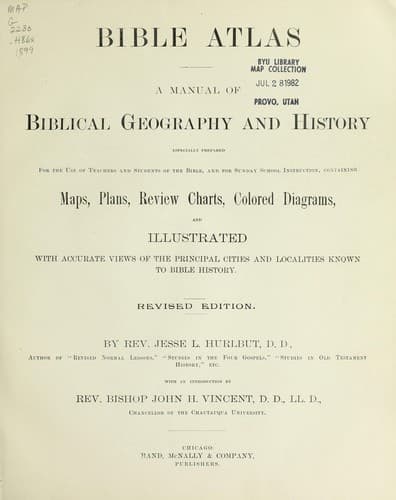
Bible Atlas: A Manual of Biblical Geography and HistoryHurlbut, Jesse Lyman
Religion
Bible Atlas: A Manual of Biblical Geography and History
Hurlbut, Jesse Lyman
Bible -- Geography; Bible -- Geography -- Maps; Bible -- History of Biblical events
1. _The kingdom of the Seleucidæ_, sometimes known as Syria, was founded
by Seleucus, B.C. 312. It included the largest portion of Alexander's
conquests, embracing most of Asia Minor, and those provinces of the
Bible world known as Syria, Mesopotamia, Babylonia, Persia Proper,
Southern Media, and far beyond them eastward to the Indus. Throughout
its history of 250 years, it remained a Greek government, though in
Asia, and introduced the Greek language and literature to all the lands
of the Orient.
2. _The kingdom of the Ptolemies_ included Egypt, Libya, Palestine,
Phoenicia, and the southern provinces of Asia Minor. It was ruled by a
succession of Greek monarchs, descended from Ptolemy Soter, and, with
changing boundaries, endured until the death of its last queen, the
famous Cleopatra, when it became a part of the Roman empire.
3. There were other kingdoms in Asia at this time, appearing upon the
map. _Pontus_ and _Cappadocia_ intervened between the two sections of
the empire of the Seleucidæ. Southwest of the Caspian, and near the sea,
_Media Atropatene_ had gained its independence, and on the southeast
_Parthia_ was rising to power; while beyond, on the east, was
_Bactriana_. Other lands of less importance might also be named; but
these are all that are necessary to the reader of the history.
During this epoch of 125 years, Palestine remained under the control of
Egypt.
[Illustration: NINEVEH AND VICINITY.]
4. =The Syrian Supremacy=, B.C. 198-166. By the battle of Mount Panium,
Antiochus of the Seleucid line wrested Palestine from Egypt. The Syrian
domination, though short, brought to the Jews greater trials than any
previous period in their history. Jerusalem was twice taken and sacked,
the Temple was desecrated and closed, the Jewish religion was forbidden,
and those who remained steadfast to it were subjected to a cruel
persecution. The trials named in Heb. 11:35-87, belonged to this
period, when every attempt was made by Antiochus Epiphanes to destroy
the worship of Jehovah, and introduce Greek customs and religion among
the Jewish people. But the very violence of the tyranny reacted, and led
to a complete deliverance and a more thorough devotion.
5. =The Maccabean Independence=, B.C. 166-40. A priest named Mattathias
raised the banner of revolt; and, after his death, his five sons in
succession led the efforts of the Jews for freedom. The greatest of
them, though all were heroes, was Judas, called Maccabeus, "the hammer."
In B.C. 165 he took possession of Jerusalem; and, after his death, his
brother Simon won the recognition of the freedom of Palestine. Other
Maccabean princes extended the boundaries of the land over Edom, Samaria
and Galilee. Under a succession of these rulers, also called Asmonean
kings, Palestine was virtually independent, though nominally subordinate
to either Syria or Egypt.
[Illustration: PALESTINE UNDER THE MACCABEES.
B.C. 100.]
Public-domain text, read in full here on John Shaqi.
Reviews
Reviews
No reviews yet
Be the first to share your thoughts on this work.
Elsewhere in the archive
Join the Discussion
Join the discussion
Sign in to leave a comment or review.
Sign InorCreate an account