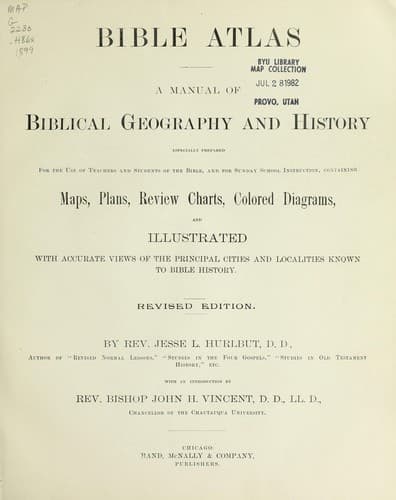
Bible Atlas: A Manual of Biblical Geography and HistoryHurlbut, Jesse Lyman
Religion
Bible Atlas: A Manual of Biblical Geography and History
Hurlbut, Jesse Lyman
Bible -- Geography; Bible -- Geography -- Maps; Bible -- History of Biblical events
6. =The Roman Supremacy=, B.C. 40-A.D. 70. Perhaps this period should
begin with B.C. 63, when the Roman general Pompey entered Jerusalem, and
the Romans began to exercise a controlling influence. But the
representatives of the Maccabean line were allowed to reign until B.C.
40, when they were set aside, and Herod the Great, an Idumean (Edomite),
was made king by the Romans. It was in the closing portion of his reign
that JESUS CHRIST was born. The last 70 years of the Roman period belong
to New Testament history, and will be considered in connection with the
maps of that period.
THE ROMAN EMPIRE.
THE last of the Old World empires was that having its capital on the
seven hills of ROME. Like most of the others, it was the dominion of a
single city; but, unlike others, it represented the conquests, not of a
single conquering king, as Nebuchadnezzar or Cyrus, but of a
self-governing and conquering people; and, unlike its predecessors, it
was not a loose aggregation of states, ready to fall apart as soon as
the hand that fettered them was removed, but an empire, carefully welded
together, building up in every land its own civilization, and developing
a national unity which held its possessions together for a thousand
years.
[Illustration: THE COLOSSEUM AT ROME.]
At the close of the Old Testament period, the Persian empire stood in
all its power. Four hundred years later, at the opening of the New
Testament epoch, the Persian empire had given place to that of
Alexander; that had broken up into many fragments; and most of these in
turn had been united under the eagles of Rome. The world's capital had
moved westward, and the Mediterranean was now a Roman lake. The
principal provinces of this empire, omitting minor subdivisions, were:
I. =European Provinces.= 1. Italy. 2. Hispania, now known as Spain,
subdivided into three provinces. 3. Gallia, now France, including also
parts of Germany and the Netherlands, embracing five provinces. 4. The
Danubian provinces of Rhætia, Noricum, Pannonia, and Moesia, to which
Dacia was afterward added by the emperor Trajan. 5. The Grecian
provinces of Thracia, Macedonia, Achaia, and Illyricum.
II. =The Insular Provinces= were: 1. Britannia. 2. Sicilia. 3. Sardinia
and Corsica, united. 4. Cyprus. The other islands were attached, either
to these, or to governments upon the mainland.
III. =The Asiatic Provinces= were: 1. Asia, a term referring only to the
western end of Asia Minor. 2. Pontus and Bithynia, united. 3. Galatia.
4. Pamphylia and Lycia. 5. Cilicia. 6. Syria, of which Palestine was a
part. To these were added, after the New Testament period, Armenia,
Mesopotamia, and Arabia Petræa; but they were soon lost to the empire.
IV. =The African Provinces= were: 1. Ægyptus, or Egypt. 2. Cyrenaica,
called, in Acts 2:10, "parts of Libya about Cyrene." 3. Africa, the
district around Carthage. 4. Mauritania, now Morocco.
Public-domain text, read in full here on John Shaqi.
Reviews
Reviews
No reviews yet
Be the first to share your thoughts on this work.
Elsewhere in the archive
Join the Discussion
Join the discussion
Sign in to leave a comment or review.
Sign InorCreate an account