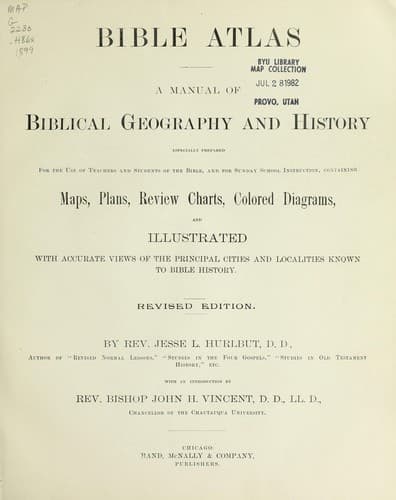
Bible Atlas: A Manual of Biblical Geography and HistoryHurlbut, Jesse Lyman
Religion
Bible Atlas: A Manual of Biblical Geography and History
Hurlbut, Jesse Lyman
Bible -- Geography; Bible -- Geography -- Maps; Bible -- History of Biblical events
4. =Peræa= extended from the Jordan and the Dead Sea on the west to the
Syrian desert on the east, and from the river Arnon on the south to the
town of Pella on the north; nearly corresponding to the location of the
tribes of Reuben and Gad. The word means "beyond"; and the country was
sometimes called (Mark 10:1) "Judæa by the farther side of Jordan." It
was inhabited during the New Testament period by Jews, among whom were
established many villages of Gentiles.
5. The remaining province has no correct geographical name. It is
sometimes called =Decapolis=; but the term is not precise, and strictly
refers to ten cities, not all of which were in the province. It embraced
no less than five sections, as may be seen upon the map. (1.)
Gaulanitis, the ancient Golan, now _Jaulan_, east of the Jordan,
Tiberias, and Lake Merom, which was then called Samachonitis. (2.)
Auranitis, now _Hauran_, the flat country of Bashan. (3.) Trachonitis,
"rugged," the mountainous district of Bashan, now known as _el Ledja_.
(4.) Iturea, now called _Jedur_, between Mount Hermon and the _Ledja_,
on the north. (5.) Batanea, an Aramaic form of the Hebrew word Bashan,
south of the Hieromax.
Decapolis was "the land of the ten cities." These were ten confederated
Gentile cities standing in Palestine; and, though surrounded by a Jewish
population, preserving their heathen character, and protected by the
Roman government. Their names, as given by different historians, do not
entirely agree; but the best list is: (1.) Scythopolis (Beth-shean).
(2.) Gadara. (3.) Gerasa. (4.) Canatha. (5.) Abila. (6.) Raphana. (7.)
Hippos. (8.) Dion. (9.) Pella. (10.) Capitolias. To these may be added:
(11.) Philadelphia (Rabbath Ammon). (12.) Damascus. As far as
identified, they are named upon the map in red letters. Many of these
cities were destroyed, and their inhabitants massacred, by the Jews, in
the beginning of the final war before the destruction of Jerusalem by
Titus.
[Illustration: PALESTINE DURING THE MINISTRY of JESUS.
A.D. 26.]
II. THE POLITICAL HISTORY OF PALESTINE, B.C. 4-A.D. 70.
1. =The Kingdom of Herod the Great= included all the provinces indicated
upon the map, and described above. This organization came to an end B.C.
4, when Herod died.
Public-domain text, read in full here on John Shaqi.
Reviews
Reviews
No reviews yet
Be the first to share your thoughts on this work.
Elsewhere in the archive
Join the Discussion
Join the discussion
Sign in to leave a comment or review.
Sign InorCreate an account