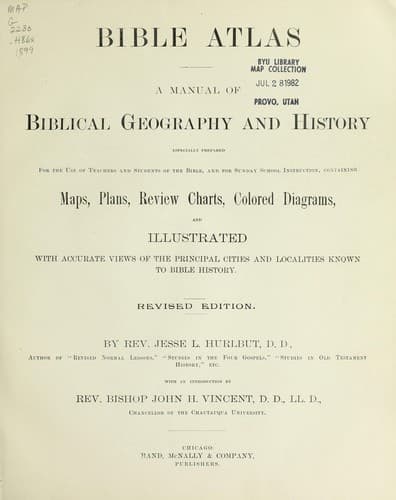
Bible Atlas: A Manual of Biblical Geography and HistoryHurlbut, Jesse Lyman
Religion
Bible Atlas: A Manual of Biblical Geography and History
Hurlbut, Jesse Lyman
Bible -- Geography; Bible -- Geography -- Maps; Bible -- History of Biblical events
2. =The Tetrarchy=, B.C. 4-A.D. 41. The word means "a government of
four," and points to the division of the kingdom after Herod's death,
when Archelaus was made tetrarch of Judæa and Samaria; Antipas (called
in the New Testament "Herod the tetrarch"), of Galilee and Peræa; and
Philip, of the fifth province, east of the Sea of Tiberias. The fourth
tetrarch was Lysanias, who ruled over the small district of Abilene,
between Mount Hermon and Damascus, a separate dominion from that of
Herod. In A.D. 6 Archelaus was deposed, and Judæa and Samaria were
annexed directly to the empire, and governed by a series of procurators,
of whom Pontius Pilate was the sixth. This was the political arrangement
of Palestine during the ministry of Jesus, of which a map is given.
3. =The Kingdom of Herod Agrippa=, A.D. 41-44. Herod Agrippa was a
grandson of Herod the Great, and an intimate friend of the emperor
Caligula, from whom he received the title of king, and all the dominions
of Herod the Great, with Abilene added; so that he reigned over more
territory than any Jewish king after Solomon. He was the "Herod the
king" who slew the apostle James, imprisoned Peter, and died by the
judgment of God at Cæsarea. (Acts 12.)
4. =The Two Provinces=, A.D. 44-70. On the death of Herod Agrippa, his
son, Herod Agrippa II., was a youth of 17. The emperor Claudius gave him
only the tetrarchies formerly held by Philip and Lysanias, "the fifth
province" of Palestine, and Abilene. Over these he reigned until the
final extinction of the Jewish state by Titus, A.D. 70, when he retired
to a private station at Rome. This was the "King Agrippa" before whom
the apostle Paul bore testimony. (Acts 25, 26.) During his reign, Judæa,
Samaria, Galilee and Peræa formed the province of Judæa, under Roman
procurators, having their headquarters at Cæsarea. When the last
rebellion of the Jews had been quelled by the destruction of Jerusalem,
the entire country was annexed to the province of Syria, and the history
of Judæa ended.
[Illustration: THE TWO PROVINCES.
A.D. 44-70.]
THE LIFE OF CHRIST.
AS THE life of Jesus Christ on earth is the most important not only in
all Bible history, but in all human history as well, it is desirable
that the Bible student, and especially the Bible teacher, should obtain
a clear understanding of its leading events, associate them with the
places where they occurred, and arrange them in chronological order. Of
the 150 principal events, about 100 are fixed as to their chronological
order by the common consent of the leading harmonists; about 25 are
agreed upon by the majority; while the remaining 25 are altogether
uncertain. In the outline here given, the authorities most relied upon
are Andrews, Robinson, Geikie, and Strong, yet no one of them is
exclusively followed. We divide the earthly life of Jesus into nine
periods, to each of which is given a separate map, so that the student
may not be confused among the various lines of the Saviour's journeying.
Public-domain text, read in full here on John Shaqi.
Reviews
Reviews
No reviews yet
Be the first to share your thoughts on this work.
Elsewhere in the archive
Join the Discussion
Join the discussion
Sign in to leave a comment or review.
Sign InorCreate an account