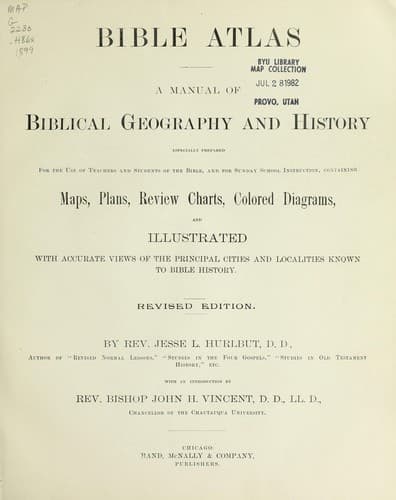
Bible Atlas: A Manual of Biblical Geography and HistoryHurlbut, Jesse Lyman
Religion
Bible Atlas: A Manual of Biblical Geography and History
Hurlbut, Jesse Lyman
Bible -- Geography; Bible -- Geography -- Maps; Bible -- History of Biblical events
The events of this period gather around seven cities. 1. =Jerusalem.=
This place has been already described. (See page 73.) 2. =Samaria= (Acts
8:5-25), the field of Philip's early ministry, was the ancient capital
of the Ten Tribes (see page 87), located 30 miles north of Jerusalem,
and 6 miles northwest of Shechem. It had been rebuilt by Herod the
Great, and named Sebaste, in honor of Augustus. It is now a village
called _Sebastiyeh_. 3. =Cæsarea= (Acts 10:1), the place where the
Gentile Cornelius became a disciple, was the Roman capital of Palestine,
and the residence of the procurators. It was called Cæsarea Stratonis,
to distinguish it from Cæsarea Philippi, under Mount Hermon; and was
located on the sea-coast, 47 miles northwest of Jerusalem; and is now a
desolate, uninhabited ruin, called _Kaisarieyeh_. 4. =Joppa=, where
Dorcas was raised to life, and Peter received a vision (Acts 9:36-43;
10:11), is one of the most ancient towns in the world, in all ages the
principal seaport of Palestine. It lies 30 miles south of Cæsarea, and
35 miles northwest of Jerusalem; and is now a flourishing city called
_Yafa_, or _Jaffa_. 5. =Damascus=, the place where Saul was converted
(Acts 9:1-25), is an ancient and famous city of Syria, 133 miles
northeast of Jerusalem, beautifully situated in a plain at the foot of
the Anti-Lebanon mountains. Recently it had a population of 150,000, but
is rapidly decaying from the diversion of the Eastern trade through the
Suez Canal. Its modern name is _el Shams_. 6. =Antioch=, seat of the
first missionary church (Acts 11:19-30), was the metropolis of northern
Syria, situated on the river Orontes, 16-1/2 miles from the
Mediterranean, and 300 miles north of Jerusalem, in a deep pass between
the Taurus and Lebanon ranges of mountains. It is now a mean village of
6,000 people, called _Antakia_. 7. =Tarsus=, the home of the apostle
Paul, was the capital of Cilicia, in Asia Minor, and one of the leading
cities of the Roman world. It was 12 miles from the Mediterranean, the
same distance from Mount Taurus, and about 80 miles northwest of
Antioch, across an arm of the sea. It is now a place of 30,000
inhabitants, called _Tersous_.
[Illustration: PLAN OF ANCIENT ANTIOCH.]
The most important events of this period may be arranged under five
journeys, which are indicated upon the map.
Public-domain text, read in full here on John Shaqi.
Reviews
Reviews
No reviews yet
Be the first to share your thoughts on this work.
Elsewhere in the archive
Join the Discussion
Join the discussion
Sign in to leave a comment or review.
Sign InorCreate an account