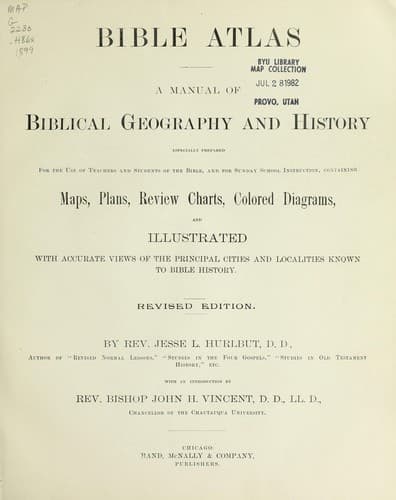
Bible Atlas: A Manual of Biblical Geography and HistoryHurlbut, Jesse Lyman
Religion
Bible Atlas: A Manual of Biblical Geography and History
Hurlbut, Jesse Lyman
Bible -- Geography; Bible -- Geography -- Maps; Bible -- History of Biblical events
DURING the seven years following the ascension of the Saviour, the
Christian church was entirely Jewish in its membership, and, so far as
we can learn, limited to the city of Jerusalem and the surrounding
villages. There was at that time no thought of the gospel for the
Gentiles, and the conception of the apostles was that the only door into
the church lay through the profession of Judaism and the rite of
circumcision. Probably the first to attain to wider views of the gospel
was Stephen, and the persecution in which he became the first martyr
arose from the tendency of his teachings toward extending among the
Gentiles the privileges of the new kingdom. This state of affairs was
suddenly ended by the death of Stephen, and the scattering of the church
at Jerusalem. The more liberally inclined of its members, when driven
abroad, were led to preach the gospel, first to Samaritans; then to
believers in the Jewish faith who had not yet submitted to circumcision,
and hence were called "Proselytes of the Gate"; and at last to the
general Gentile world. The period from the death of Stephen, A.D. 37, to
the first missionary journey of the Apostle Paul, A.D. 45, may,
therefore, be regarded as an age of transition from Jewish to Gentile
Christianity.
This period requires us to notice two provinces, Palestine and Syria.
Palestine appears at this time under several forms of government in
frequent succession. During the public life of Christ, Judæa and Samaria
were under the direct rule of Rome, governed by a procurator, while
Galilee and Peræa belonged to Herod Antipas, and the region north and
east of the Sea of Galilee, anciently called Bashan, was held by Herod
Philip, both of these having the title of _tetrarch_, "ruler of a fourth
part." In A.D. 37 Herod Agrippa received Philip's tetrarchy, and in 41
he was made king of all Palestine. ("Herod the king," Acts 12.) In A.D.
44 he died, and his dominions were divided. Judæa, Samaria, Galilee and
Peræa again became a procuratorship, under a succession of Roman rulers,
until the final destruction of the Jewish state, A.D. 70. The
principality of Bashan was given to Herod Agrippa II. in A.D. 53, and
held by him until A.D. 70. Syria, the great region north of Palestine,
extending from Damascus to Antioch, was, during this time, a province of
the Roman empire, governed by a prefect.
[Illustration: DAMASCUS.]
Public-domain text, read in full here on John Shaqi.
Reviews
Reviews
No reviews yet
Be the first to share your thoughts on this work.
Elsewhere in the archive
Join the Discussion
Join the discussion
Sign in to leave a comment or review.
Sign InorCreate an account