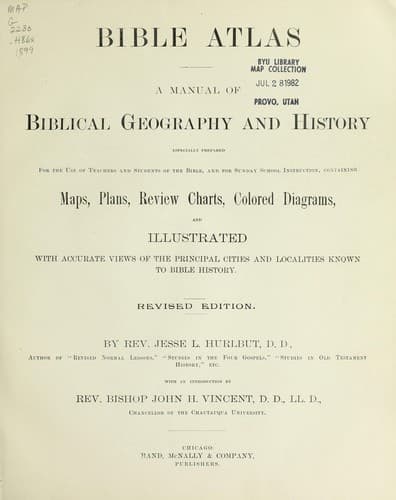
Bible Atlas: A Manual of Biblical Geography and HistoryHurlbut, Jesse Lyman
Religion
Bible Atlas: A Manual of Biblical Geography and History
Hurlbut, Jesse Lyman
Bible -- Geography; Bible -- Geography -- Maps; Bible -- History of Biblical events
6. _Samos._ (Acts 20:15.) This is an island near the mainland, 42 miles
southwest of Smyrna; and 27 miles long. It was the birthplace of the
philosopher Pythagoras. They barely touched at the island, and then
sailed across to the shore of Asia Minor.
7. _Trogyllium_ (Acts 20:15) is a town and cape on the coast of Asia
Minor, at the foot of Mount Mycale. The place at which they anchored for
the night is still called _St. Paul's Port_. On the next day they sailed
past the harbor of Ephesus without stopping, for Paul's stations were
controlled by the movements of the ship and its masters.
8. _Miletus._ (Acts 20:16-38.) This was at the mouth of the river
Mæander, 36 miles south of Ephesus; and at that time on the shore,
though now ten miles inland, by the changes in the coast. Here, while
the ship was delayed, Paul sent for the elders of the church at Ephesus,
and gave to them a farewell address of deep tenderness. This place is
now a small village, called _Melas_.
9. _Coos_, or Cos (Acts 21:1), where they next anchored, is a small
island, northwest of Rhodes; now called _Stanchio_.
10. _Rhodes_ (Acts 21:1) is an island of note in both ancient and modern
history, 13 miles from Asia Minor, 46 miles long, and 18 wide. Upon it
had stood the Colossus, a figure over 100 feet high, but overthrown by
an earthquake, B.C. 224, and prostrate at the time of Paul's visit.
11. _Patara_ (Acts 21:1) was a seaport in the province of Lycia, in Asia
Minor, opposite Rhodes. Here the vessel ended its voyage, and the
apostolic company found another, which was bound for Phoenicia. The
place is now a ruin, and buried in the encroaching sand.
12. The disciples took another ship at Patara, and sailed in a
southeasterly direction for Phoenicia, passing by Cyprus without
stopping. The vessel paused for a week at _Tyre_ to unlade its burden,
and here Paul found a church, perhaps planted by Philip the evangelist.
Tyre had once been the great commercial metropolis of the Mediterranean,
known as "the strong city" as early as the time of Joshua. It was the
capital of Phoenicia, and in Old Testament times held friendly relations
with Israel, but was idolatrous and abominably wicked. It was besieged
by Nebuchadnezzar for 13 years, was destroyed by Alexander the Great,
rebuilt by the Seleucidæ, and, in Paul's time, was still a large city.
It is now a miserable village, called _Sur_, and, in the fulfillment of
prophecy, "a place for the spreading of nets." (Ezek. 26:14.)
13. Taking ship once more, for the last time, they sailed southward
along the coast of Palestine to _Ptolemais_. (Acts 21:7.) This was the
Old Testament Accho, in the tribe of Asher, but never possessed. It was
8 miles north of Mount Carmel. In mediæval history it sustained a siege
by the Crusaders, and was known as _St. Jean d'Acre_. Here Paul spent a
day with the church, and then journeyed with his friends southward over
the Plain of Esdraelon and Mount Carmel.
Public-domain text, read in full here on John Shaqi.
Reviews
Reviews
No reviews yet
Be the first to share your thoughts on this work.
Elsewhere in the archive
Join the Discussion
Join the discussion
Sign in to leave a comment or review.
Sign InorCreate an account