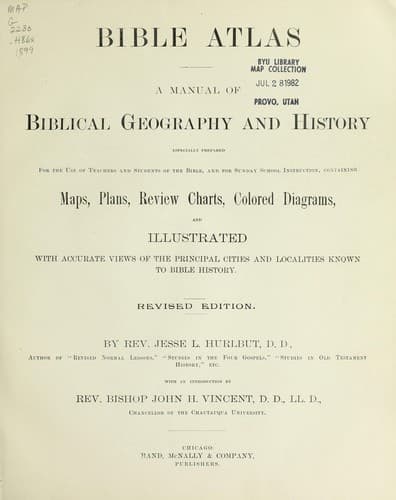
Bible Atlas: A Manual of Biblical Geography and HistoryHurlbut, Jesse Lyman
Religion
Bible Atlas: A Manual of Biblical Geography and History
Hurlbut, Jesse Lyman
Bible -- Geography; Bible -- Geography -- Maps; Bible -- History of Biblical events
14. At _Cæsarea_, the next station, they were entertained by Philip,
who, years before, had been driven out of Jerusalem by Saul of Tarsus.
(See Philip's Journey, page 112.) Cæsarea was the Roman capital of
Palestine, and was in all respects a heathen city, though containing
many Jews. Here Paul received a message from the aged prophet Agabus,
warning him not to go to Jerusalem; but he persisted in his purpose.
15. For the fifth time in his life as a Christian, and for the last
time, Paul entered the city of JERUSALEM, from which he was soon to go
forth "the prisoner of the Lord."
OUTLINE FOR REVIEW.
I. _Outward Journey._ 1. Antioch. 2. Galatia. 3.
Phrygia. 4. Ephesus. 5. Troas. 6. Macedonia.
(Philippi.) 7. Greece. (Corinth.)
II. _Return Journey._ 1. Philippi. 2. Troas. 3.
Assos. 4. Mitylene. 5. Chios. 6. Samos. 7.
Trogyllium. 8. Miletus. 9. Coos. 10. Rhodes. 11.
Patara. 12. Tyre. 13. Ptolemais. 14. Cæsarea. 15.
Jerusalem.
THE VOYAGE TO ROME.
The last of Paul's recorded journeys was that which he took as a
prisoner under Roman power. He was seized by a Jewish mob in the Court
of the Women in the Temple (see plan of the Temple on page 141), in or
near the room set apart for the ceremonies of a Nazarite's vow. Dragged
by the crowd into the Court of the Gentiles, he would have been slain
but for the arrival of a company of Roman soldiers from the Tower of
Antonia. He made an address to the throng from the stairs leading from
the Court of the Gentiles to the Tower, and was then taken to the prison
in the tower.
1. From _Jerusalem_ he began his journey, as a prisoner. The immediate
cause of his departure from the city was the information received by the
Roman officer in charge of the Tower of Antonia, that a band of Jews had
formed a plan to slay Paul. That night he was sent, under a strong
escort, out of the reach of his enemies.
2. The guard paused at _Antipatris_ (Acts 23:31, 32), beyond which the
soldiers were not needed, so they were sent back, and Paul journeyed the
rest of the way under an escort of cavalry. Antipatris was built by
Herod the Great, and named for his father, Antipater. It was 26 miles
southeast of Cæsarea, on the direct road from Jerusalem, and 16 miles
northeast of Joppa. Its location is not identified with certainty, but
is probably to be found at a ruin known as _Ras el' Ain_.
3. The apostle was taken to _Cæsarea_ (Acts 23:33), where he was
remanded to prison. Here he remained for more than two years, was tried
by Felix, and made his memorable defense before the younger Herod
Agrippa. (Acts 24-26.) Having appealed, as a Roman citizen, to the
supreme court of the emperor at Rome, he was sent on shipboard for the
voyage with a company of prisoners, and a guard commanded by the
centurion Julius. Luke and Aristarchus were with Paul on the vessel.
(Acts 27:1, 2.)
Public-domain text, read in full here on John Shaqi.
Reviews
Reviews
No reviews yet
Be the first to share your thoughts on this work.
Elsewhere in the archive
Join the Discussion
Join the discussion
Sign in to leave a comment or review.
Sign InorCreate an account