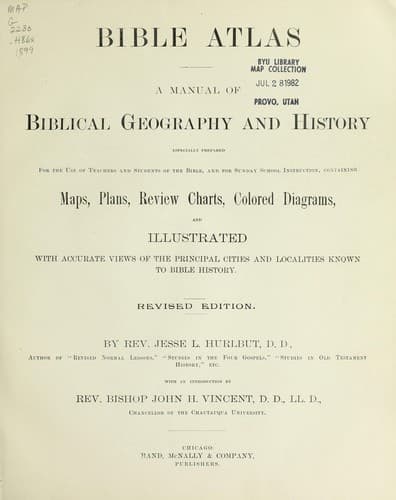
Bible Atlas: A Manual of Biblical Geography and HistoryHurlbut, Jesse Lyman
Religion
Bible Atlas: A Manual of Biblical Geography and History
Hurlbut, Jesse Lyman
Bible -- Geography; Bible -- Geography -- Maps; Bible -- History of Biblical events
4. _Thyatira_ (Rev. 2:18) was a city in the province of Lydia, on the
road from Pergamos to Sardis. It was founded by Alexander the Great, who
planted it with people from Macedonia, which may account for the fact
that "Lydia of Thyatira" was found by Paul at Philippi, in Macedonia. It
was a prosperous manufacturing town, but never a great city, and its
scarlet cloth still has a reputation throughout the Orient. It is now a
place with a population of from 17,000 to 20,000, and is called _ak
Hissar_, "white castle."
5. _Sardis_ (Rev. 3:1) lay 30 miles south of Thyatira, between the river
Hermus and Mount Tmolus. It was the capital of Croesus, the wealthy king
of Lydia, whose empire was overthrown by Cyrus the Great. After the time
of Alexander it belonged to the kingdom of Pergamos, until its
absorption into the Roman empire. It was a place of extensive commerce,
which led to prosperity, and the worldliness of the Christian church,
rebuked in the message of the Revelation. It is now a miasmatic region,
with scarcely an inhabitant, and bears the name _Sert Kalessi_.
6. _Philadelphia_ (Rev. 3:7) was about 25 miles southeast of Sardis, on
the river Cogamus, a branch of the Hermus. It was built and named by
Attalus Philadelphus, king of Pergamos, and was the centre of a rich
farming region, which has kept it inhabited through all the vicissitudes
of the centuries. It was destroyed by an earthquake A.D. 17, but
rebuilt. Its population is now about 10,000, and its modern name is
_Allah Shehr_, "city of God."
7. _Laodicea_ (Rev. 3:14) was the capital of Phrygia, and was 50 or 60
miles from Philadelphia, according to route. It was on the bank of the
Lycus, near Hierapolis and Colosse. Its ancient name was Diospolis, but
was changed by the Syrian king, Seleucus II., in honor of his wife,
Laodice. In A.D. 62 it was destroyed by an earthquake; but its people
were sufficiently rich to decline the aid of the Romans in rebuilding
their city. Its worldly prosperity was reflected in its church, which
received the sharpest rebukes of the Revelator. The Mohammedans
destroyed the city, which is now a mass of ruins, surrounding a village
called _Eski-hissar_.
It will be noticed, that, in the order of the Revelation, the Seven
Churches are arranged in a circuit, as one would find them, starting
from Ephesus, and traveling north to Smyrna and Pergamus, then southeast
to Thyatira, Sardis and Philadelphia, until the southern and eastern
limit is reached at Laodicea.
OUTLINE FOR REVIEW.
I. Let the teacher draw the outlines of the coast
of both Europe and Asia, and call attention to the
lands as already noticed under other maps. Then
locate and name the principal _Islands_,
especially those referred to in Paul's voyage to
Palestine (map on page 122), and _Patmos_.
II. Explain the four meanings of the name Asia, as
used by the ancients.
Public-domain text, read in full here on John Shaqi.
Reviews
Reviews
No reviews yet
Be the first to share your thoughts on this work.
Elsewhere in the archive
Join the Discussion
Join the discussion
Sign in to leave a comment or review.
Sign InorCreate an account