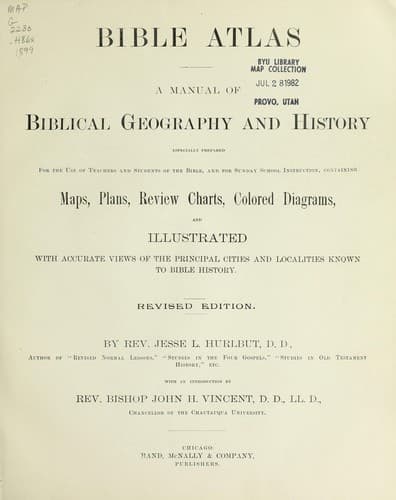
Bible Atlas: A Manual of Biblical Geography and HistoryHurlbut, Jesse Lyman
Religion
Bible Atlas: A Manual of Biblical Geography and History
Hurlbut, Jesse Lyman
Bible -- Geography; Bible -- Geography -- Maps; Bible -- History of Biblical events
III. Locate and name the _Seven Churches_, as
given in Revelation. _Ephesus, Smyrna, Pergamos,
Thyatira, Sardis, Philadelphia, Laodicea._
THE TABERNACLE.
[Illustration: THE TABERNACLE, ACCORDING TO FERGUSSON.]
I. =Its Origin.= The Tabernacle was the tent in which the emblems for
divine worship were kept from the time of Moses to that of Solomon, 400
years. It represented the idea of God dwelling among his people, in the
centre of the camp of Israel. The earliest institution for worship was
the Altar, built wherever the patriarchs pitched their tents. Next we
find a place consecrated and kept for the house of God, as Jacob's
pillar at Bethel, to which the patriarch returned as to a sanctuary in
after years. The Tabernacle arose when Israel was no longer a family,
but a nation, needing a centralizing power and a system of worship as
the uniting element among the tribes. It was erected under the direction
of Moses, by divine command, while the Israelites were encamped at Mount
Sinai.
II. =Its History.= During all the journeys of the Israelites through the
wilderness, the Tabernacle stood in the centre of their camp, or, while
on the march, was taken apart and carried by the Levites. At the time of
the conquest, it remained at Gilgal, the fortified camp of Israel, near
Jericho. After the war it was established at Shiloh, in the tribe of
Ephraim, where it continued until the great defeat of Israel at Ebenezer
(1 Sam. 4:1-11), when the ark was taken, and probably Shiloh was
ravaged. The Tabernacle was removed to Nob, in the tribe of Benjamin,
where it remained until Saul's slaughter of the priests. (1 Sam. 21:1-6;
22:18, 19.) It seems to have been at Gibeon, while the ark was in
seclusion at Kirjath-jearim. (2 Chron. 1:4.) There is no mention of the
Tabernacle after the building of the Temple; but a Jewish tradition is
that its curtains were rolled up and laid away in one of the rooms
connected with the Temple.
III. =The Departments of the Tabernacle.= This will require us to
notice: 1. The Court. 2. The Altar. 3. The Laver. 4. The Tent. 5. The
Holy Place. 6. The Holy of Holies. The dimensions of these are given in
cubits; and, as the authorities differ as to the length of the cubit, we
will consider it here as being about a foot and a half, or 18 inches,
the length generally given.
Public-domain text, read in full here on John Shaqi.
Reviews
Reviews
No reviews yet
Be the first to share your thoughts on this work.
Elsewhere in the archive
Join the Discussion
Join the discussion
Sign in to leave a comment or review.
Sign InorCreate an account