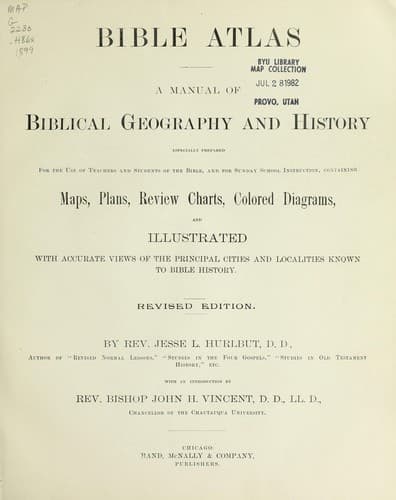
Bible Atlas: A Manual of Biblical Geography and HistoryHurlbut, Jesse Lyman
Religion
Bible Atlas: A Manual of Biblical Geography and History
Hurlbut, Jesse Lyman
Bible -- Geography; Bible -- Geography -- Maps; Bible -- History of Biblical events
larger than the other, and therefore extending beyond it. 3. Next came a
covering of "rams' skins dyed red." 4. Over all was spread a covering
skin, called in the Hebrew, _tachash_, translated "badgers' skins," but
supposed by many to mean _seal skin_, taken from animals found in the
Red Sea, and intended to preserve the roof from the effects of the
weather. The front, on the eastern end, was protected by a hanging of
fine linen, embroidered in blue, purple and scarlet, and resting upon
the five pillars named above. (Review. 1. Purpose. 2. Dimensions. 3.
Form. 4. Walls. 5. Rings. 6. Bases. 7. Pillars. 8. Coverings. 9. Front.)
5. _The Holy Place._ This was the larger of the two rooms, and was
separated from the smaller room within by the _Vail_, which was an
embroidered curtain hanging upon four pillars. Its dimensions were 15
feet in width and 30 feet in length, with walls 15 feet high. There is
no mention of a floor, and probably there was none. It contained three
articles of furniture. On the right of a person entering, midway between
the two ends of the room, stood the _Table_, made of shittim wood
(acacia), covered with gold; it was 3 feet long, a foot and a half wide,
2 feet 3 inches high, and surrounded with a "crown," or ornamental band,
of gold. On the corners were rings, through which rods were passed, to
carry it from place to place. On this table were kept 12 loaves of
unleavened bread, which were renewed every Sabbath. On the left,
opposite to the table, was the _Lamp-stand_, generally called the
Candlestick, but incorrectly, as it contained lamps, not candles. This
was a tree of gold, probably 40 inches high, having three branches on
each side of the central trunk, so arranged that the seven summits, each
holding a lamp, stood in a horizontal line. It is uncertain whether the
lamps were kept burning at all times, or only during the night. Directly
in front of the vail, at the western end of the Holy Place, stood the
_Altar of Incense_. This was of acacia wood, overlaid with gold, whence
it was frequently called "the golden altar." It was a foot and a half
square, and three feet high. It had horns on its corners, and rings for
carrying, and an opening in the top, wherein was placed daily a censer
full of incense, which was lighted by live coals from the altar of burnt
offering in the court. The lighting of the incense with common fire was
the crime for which the two elder sons of Aaron "died before the Lord."
(Lev. 10:1, 2.) Into the Holy Place the priests entered daily, to trim
and refill the lamps, and offer the incense. (Review. 1. Vail. 2.
Dimensions. 3. Table. 4. Lamp-stand. 5. Altar of Incense. 6. Daily
uses.)
Public-domain text, read in full here on John Shaqi.
Reviews
Reviews
No reviews yet
Be the first to share your thoughts on this work.
Elsewhere in the archive
Join the Discussion
Join the discussion
Sign in to leave a comment or review.
Sign InorCreate an account