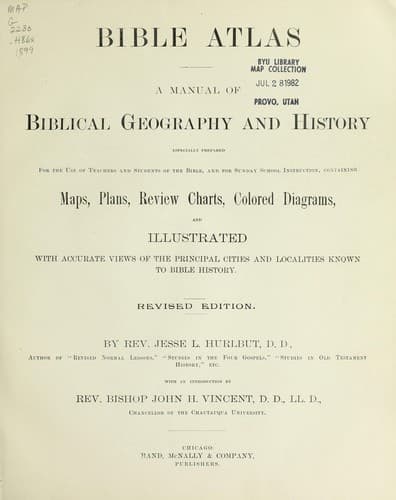
Bible Atlas: A Manual of Biblical Geography and HistoryHurlbut, Jesse Lyman
Religion
Bible Atlas: A Manual of Biblical Geography and History
Hurlbut, Jesse Lyman
Bible -- Geography; Bible -- Geography -- Maps; Bible -- History of Biblical events
(Lev. 6:10, 11.) 2. _Shovels_, for taking
off coals of fire to put in the censers. 3. _Basins_, for receiving and
carrying the blood of offerings. 4. _Flesh-hooks_, for placing the
sacrifice on the fire. 5. _Fire-pans_, for carrying the fire while on
the march. (Note for Review. 1. Situation. 2. Dimensions. 3. Horns. 4.
Compass. 5. Grate. 6. Earth contents. 7. Rings. 8. Fire. 9. Sacrifices.
10. Approach. 11. Utensils.)
[Illustration: THE TABLE OF SHEW-BREAD.]
3. _The Laver_ is less minutely described than the altar. It was a large
tank for holding water, an abundance of which was needed in the
sacrifices, and was made out of the metallic "looking-glasses" of the
women who worshiped at the Tabernacle. (Exod. 38:8.) It stood at the
door of the Tabernacle, and west of the altar. (Exod. 30:18.) With it is
mentioned "its foot," which was probably a lower basin, into which the
water ran from above, made to prevent the earth around from becoming
saturated with water. Its size and form are not stated in the account.
(Review. 1. Purpose. 2. Material. 3. Place. 4. Foot.)
4. _The Tent._ This was the Tabernacle proper, to which the court was
the adjunct. It stood as the representation of God's house, wherein he
dwelt in the midst of his own chosen people. It was 15 feet wide and
high, and 45 feet long, divided into two rooms by a curtain, or vail.
Though many details are given, yet it is not possible to give certain
conclusions either concerning its plan of construction, or even its
general appearance. For example: some authorities conclude that the
curtained roof was flat, or even sagging downward in the middle, while
others are sure that it was pointed, by means of a ridge-pole, as
represented in our engraving. We consider neither as certain, but
incline to the latter opinion. The walls and rear end of the tent were
made of upright boards, covered with gold, each 15 feet high, and 2 feet
3 inches wide; of which there were 20 boards on each side, and 10 in the
rear, while the front was open. Upon each board were rings of gold, so
arranged that, when the walls were erected, the rings were in three
rows, and through them long poles were passed to hold the structure
together. Each board was furnished at its lower end with two tenons,
which fitted into mortises in bases of solid silver, each weighing
nearly 100 pounds. These bases stood side by side, forming a firm and
continuous foundation, and protecting the lower ends of the boards from
decay. The roof of the tent was supported by pillars, of which there
seem to have been five in the front (Exod. 36:38), and probably as many
in the rear. These were covered with gold, and rested upon bases of
brass. The covering of the Tabernacle consisted of four curtains, one
over another. 1. A covering called the "tabernacle cloth," of linen,
woven in various colors, and embroidered with figures of cherubim. 2.
Over this was stretched a covering of cloth made from goat's hair,
Public-domain text, read in full here on John Shaqi.
Reviews
Reviews
No reviews yet
Be the first to share your thoughts on this work.
Elsewhere in the archive
Join the Discussion
Join the discussion
Sign in to leave a comment or review.
Sign InorCreate an account