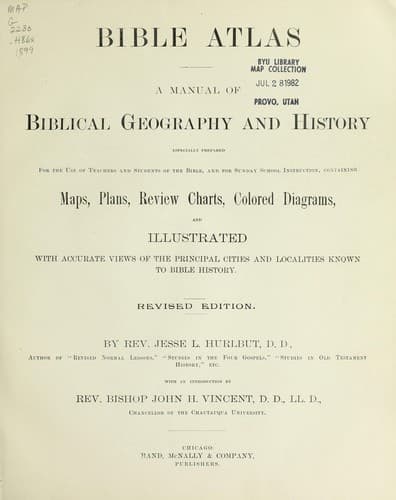
Bible Atlas: A Manual of Biblical Geography and HistoryHurlbut, Jesse Lyman
Religion
Bible Atlas: A Manual of Biblical Geography and History
Hurlbut, Jesse Lyman
Bible -- Geography; Bible -- Geography -- Maps; Bible -- History of Biblical events
THE student of the Bible meets with some difficulty in adapting the
names of weights, measures and coins, to the standards now in use, and
finds that the authorities are not agreed upon the precise signification
of the Bible terms used in relation to these subjects. These
difficulties and discrepancies arise from three facts: 1. The Oriental
mind has never been accustomed to the exactness of our systems of
measurement. Among eight cubit measures found on the Egyptian monuments,
no two were precisely alike. 2. The models or standards of weights and
measures referred to in Hebrew history were long ago lost, and it is not
easy to reproduce them. 3. The Jews adopted the measurements of peoples
among whom they were dispersed, yet often retained the names of such of
their own as were nearest to them in amount, so that at different
periods in Bible history the standard was different. The same word may
refer to different measurements at different times. We have adopted in
this section the measurements of F. R. and C. R. Conder in "The Hand
Book of the Bible," except where other authorities are specified.
[Illustration: SMALLER MEASURES OF LENGTH.]
I. =Smaller Measures of Length.= 1. The lowest dimension, as in our own
table of linear measure, was the Barleycorn. 2. Two barleycorns laid
endways made the Finger-breadth (Hebrew, Atzbah), two-thirds of an inch.
3. Four finger-breadths made the Palm (Heb., Tupah), 2-2/3 inches. 4.
Sometimes the Hand-breadth and Palm are the same; elsewhere, the
hand-breadth (Heb., Zereth) is double the palm, or 5-1/3 inches. 5.
Three palms made the Span (Heb., Sit), 8 inches, the width of the
outspread hand, from the end of the thumb to that of the little finger.
6. Four palms made the Foot (Heb., Regal), 10-2/3 inches. 7. Six palms
made the Cubit (Heb., Ameh), 16 inches (Conder), or the distance from
the elbow to the tip of the middle finger, when held in a straight line.
The cubit, however, varied (just as the pound with us varies in troy and
avoirdupois weight), as indicated in the expressions "the cubit of a
man" (Deut. 3:11), "a great cubit" (Ezek. 41:8), etc. In the length of
the cubit, authorities vary from 15 to 21 inches. We have adopted the
general opinion, and place it, conjecturally, at a foot and a half, or
18 inches.
Public-domain text, read in full here on John Shaqi.
Reviews
Reviews
No reviews yet
Be the first to share your thoughts on this work.
Elsewhere in the archive
Join the Discussion
Join the discussion
Sign in to leave a comment or review.
Sign InorCreate an account