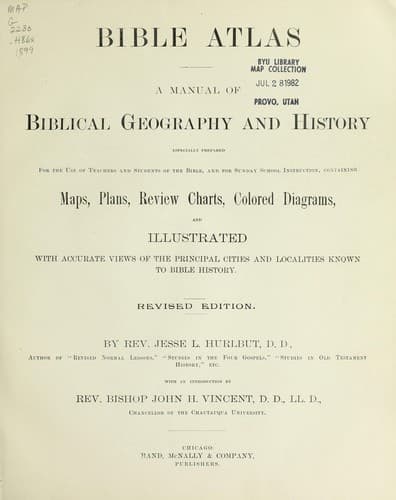
Bible Atlas: A Manual of Biblical Geography and HistoryHurlbut, Jesse Lyman
Religion
Bible Atlas: A Manual of Biblical Geography and History
Hurlbut, Jesse Lyman
Bible -- Geography; Bible -- Geography -- Maps; Bible -- History of Biblical events
II. =Larger Measures of Length.= The cubit (reckoned more precisely at
16 inches) is here regarded as the unit of measurement. 1. The Fathom
was 6 or 6-1/2 feet. 2. The Reed (Heb., Keneh; compare our word _cane_)
was 4 cubits, according to Conder, but 6 cubits according to other
authorities, thus varying between 5-1/3 feet and 8 feet. 3. The Furlong
(named only in the New Testament) was a Greek measurement (Stadium), of
606-3/4 feet, or 53-1/4 feet less than our furlong. 4. The Mile (Matt.
5:41) was 1,618 yards. The Hebrew mile is not referred to in the Bible,
but was of two kinds, "the small mile" (Heb., Mil), being about 1,000
cubits, or about a quarter of our mile; and "the long mile," twice as
far. 5. The Sabbath Day's Journey is stated by Conder at 2,000 cubits,
or half an English mile; but by most other writers at seven-eighths of
our mile. 6. The Day's Journey was variable, from 10 to 30 miles;
generally about 20 miles. So most authorities decide, but Conder gives
it at 4-3/4 miles.
III. =Dry Measures of Capacity.= 1. The Cab (2 Kings 6:25), 96 cubic
inches, or 675 thousandths of a quart. 2. The Omer (Exod. 16:36)
contained 172-8/10 cubic inches, or about 2-1/2 quarts. 3. The Seah (in
Greek, Modios) was the ordinary household measure of quantity,
translated, generally, "measure" in our Bibles, but in Matt. 5:15
"bushel." It contained six times as much as the cab, or a little over a
peck; according to Conder, 1.012 pecks; according to the Revised Version
(Matt. 13:33, marginal note), a peck and a half. 4. The Ephah (Exod.
16:36) contained 3 seahs, or 10 omers; about three-quarters of a bushel.
5. The Cor contained 10 ephahs, or 7-1/2 bushels. The cor is also called
"the homer" (Isa. 5:10), which is to be carefully distinguished from the
omer, which contained one-hundredth of its quantity. The two words are
not alike in the Hebrew. It will be noticed that the omer, the ephah and
the cor (or homer) formed a decimal scale of measurement.
[Illustration: DRY MEASURES.]
IV. =Liquid Measures of Capacity.= 1. The Auphauk (not named in the
Bible) was the smallest, containing 6 cubic inches, or 675 thousandths
of a gill. 2. The Log (Lev. 14:10), four times as large as the auphauk,
was "six egg-shells full," 24 cubic inches, or a little more than half a
pint (675 thousandths). 3. The Hin (Exod. 29:40) contained 12 logs, or a
little over a gallon. 4. The Seah (see above, under Dry Measures)
contained twice as much as the hin. 5. The Bath, containing 3 seahs or 6
hins, contained 1,728 cubic inches, or 6.036 gallons. Besides these, the
New Testament names two Greek measures, the Metretes (John 2:6,
"firkins"), equivalent to 10-1/3 gallons; and the Choenix (Rev. 6:6,
"measure"), about a pint and a half.
[Illustration: LIQUID MEASURES.]
Public-domain text, read in full here on John Shaqi.
Reviews
Reviews
No reviews yet
Be the first to share your thoughts on this work.
Elsewhere in the archive
Join the Discussion
Join the discussion
Sign in to leave a comment or review.
Sign InorCreate an account