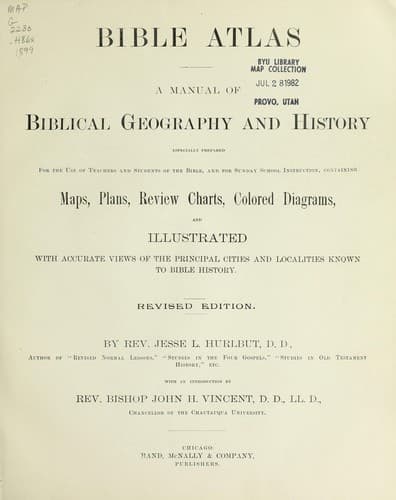
Bible Atlas: A Manual of Biblical Geography and HistoryHurlbut, Jesse Lyman
Religion
Bible Atlas: A Manual of Biblical Geography and History
Hurlbut, Jesse Lyman
Bible -- Geography; Bible -- Geography -- Maps; Bible -- History of Biblical events
V. =Measures of Weight.= (From the Oxford Teacher's Bible.) 1. The
Gerah, "a bean," weighed a little less than half of a dram avoirdupois
(.439 dram). 2. The Bekah, 10 gerahs, weighed about a quarter of an
ounce (4.39 drams). The word means "half," _i. e._, of a shekel. 3. The
Shekel, "weight," used as a silver coin, 2 bekahs, weighed 8.9 drams. 4.
The Maneh (Greek, Mina), 60 shekels (Conder says 50 shekels, which would
agree with paragraph VI., below), 2 lbs. 1 oz. 5. The Talent, "circle,"
meaning "an aggregate sum," 50 manehs, weighing 102 lbs. 14 ozs. The
weights are of lower degree than those in common use at present, because
in the early times money was weighed, and not counted, and exact
weighing was necessary with gold and silver.
VI. =Measures of Value.= Two systems of money are referred to in the
Bible: the Hebrew, or that in use in Old Testament times and lands; and
the Roman, which was used during the New Testament period. In the Hebrew
system the weights referred to in paragraph V. were used in silver as
measures of value. 1. The Gerah (Exod. 30:13) was the lowest, and was
worth 2-3/4 cents. 2. The Bekah, 10 gerahs (Exod. 38:26), was worth
27-37/100 cents, or about 2 cents more than our quarter of a dollar. 3.
The Shekel, 2 bekahs, was worth 54-3/4 cents, or about 5 cents more than
half a dollar. 4. The Maneh, or Mina, 50 shekels (Luke 19:13, "pound"),
$27.37-1/2. 5. The Talent of Silver, 60 manehs, $1,642.50. 6. The Talent
of Gold was nearly twenty times as valuable, being estimated at $26,280.
7. So the Shekel of Gold was worth, in the same proportion of weight
with the ordinary shekel of silver, $8.75. It is to be remembered that a
given amount of coin in those times would purchase ten times as much as
now.
[Illustration: This is a copper coin, a quarter-gerah, worth about half
a cent; was made about the time of Alexander the Great, B.C. 325.]
[Illustration: A silver coin, three-quarters of a shekel, called a
_righia_, used especially for paying the temple tax. It was worth about
40 cents.]
The Greek and Roman coins are chiefly referred to in the New Testament.
The smallest was the Lepton (Mark 12:42, "mite"), worth a fifth of a
cent. 2. The Quadrans (Mark 12:42, "farthing"), 2 mites, or less than
half a cent. 3. The Assarion (Matt, 10:29, "farthing"), four times the
quadrans, or 1-3/5 cents. Notice that two coins, one worth four times as
much as the other, are both translated "farthing" in our version. 4. The
Denarius (Matt, 22:19, "penny"), 10 times the assarion, or 16 cents. It
was the latter which in Christ's time bore the face of the Roman
emperor.
[Illustration: No. 1
The smallest copper coin in use among the Jews, the _lepton_, called in
Hebrew _chalcous_, "copper money." The widow's mite was of this coin.]
[Illustration: No. 2
The denarius, or penny, bearing the face of the emperor Tiberius.]
[Illustration: BETHANY.]
INDEX TO MAP OF PALESTINE.
(SURROUNDING COUNTRY INCLUDED.)
Public-domain text, read in full here on John Shaqi.
Reviews
Reviews
No reviews yet
Be the first to share your thoughts on this work.
Elsewhere in the archive
Join the Discussion
Join the discussion
Sign in to leave a comment or review.
Sign InorCreate an account