Bible Atlas: A Manual of Biblical Geography and History — John Shaqi
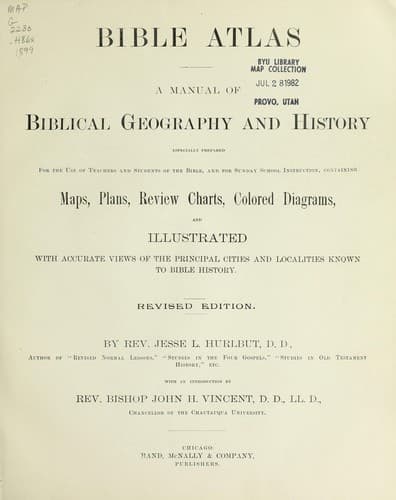
Bible Atlas: A Manual of Biblical Geography and HistoryHurlbut, Jesse Lyman
Religion
Bible Atlas: A Manual of Biblical Geography and History
Hurlbut, Jesse Lyman
Bible -- Geography; Bible -- Geography -- Maps; Bible -- History of Biblical events
1. =Armenia= is a name nowhere used in the original Scriptures, but in
our version is a translation of the word "Ararat," which word properly
appears in place of "Armenia" in the Revised Version. The province
embraces the lofty plateau and mountain group between the Caspian and
Black Seas, and north of Mesopotamia and Assyria, the source of four
great rivers, the Araxes, Tigris, Euphrates, and Acampsis, the latter
pouring into the Black Sea. Its boundaries are: upon the north, the
Caucasus Mountains; on the east, Media and the Caspian Sea; on the
south, Media, from which it is separated by the Araxes, and Assyria,
from which it is divided by Mount Masius; and on the west, the
Euphrates, separating it from Asia Minor. Tradition states that it was
settled by Haïk, a grandson of Japhet; and the earliest history names it
as tributary to Assyria. Excepting the resting of Noah's ark upon one of
its mountains, few events of Scripture are associated with it.
2. =Media= is in the original the same word as Madai, the son of Japhet.
(Gen. 10:2.) Its boundaries are the river Araxes and the Caspian Sea on
the north, the great salt desert of Iram on the east, Persia on the
south, and the Zagros Mountains, separating it from Assyria and Armenia.
A branch of the Zagros Mountains, running eastward, divides it into two
portions, anciently known as Media Atropatene (the one northward) and
Media Magna. In each of these provinces the principal city was called
Ecbatana. The Medes were of the Aryan or Japhetic stock, and were always
a warlike and independent people. Though conquered by Assyria, their
land was never formally annexed to the Assyrian empire. In B.C. 633 the
Median kingdom was established, and soon became supreme over Assyria,
Armenia, and Persia, and formed the Medo-Persian empire, which succeeded
to the power of Babylon in the East, B.C. 536. After that date the
history of Media is lost in that of Persia.
3. =Persia= was originally a small province on the Persian Gulf, still
known as _Fars_. But Persia Proper included, besides the sandy plain on
the gulf, a mountainous plateau north of it, and was bounded by Media on
the north, by Carmania on the east, by the Persian Gulf on the south,
and by Elam on the west. Its people were of the Aryan race, and at first
subject to the Medes. They revolted under Cyrus the Great, and became
the controlling power in the conquest of Nebuchadnezzar's dominion. The
Persian empire arose to greatness at the fall of Babylon, B.C. 536,
conquered and ruled over all the lands from India to Ethiopia, and was
by far the greatest of the great Oriental monarchies. It was subjected
by Alexander the Great, B.C. 330. The capital of the Persian empire was
Susa, called in the Bible "Shushan the Palace" (Esther 1:2); which was,
however, situated not in Persia Proper, but in Elam. The most important
places in the province were Persepolis (its capital at one period),
Pasargada, and Mesambria, none of which are named in the Bible.
Public-domain text, read in full here on John Shaqi.
Reviews
Reviews
No reviews yet
Be the first to share your thoughts on this work.
Join the Discussion
Join the discussion
Sign in to leave a comment or review.
Sign InorCreate an account