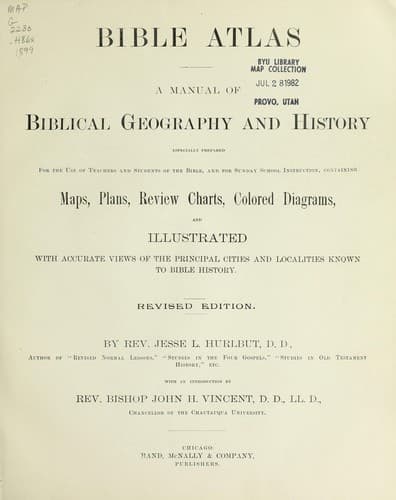
Bible Atlas: A Manual of Biblical Geography and HistoryHurlbut, Jesse Lyman
Religion
Bible Atlas: A Manual of Biblical Geography and History
Hurlbut, Jesse Lyman
Bible -- Geography; Bible -- Geography -- Maps; Bible -- History of Biblical events
In most lands the earliest people have been of an unknown race, as the
mound builders of America and the cave dwellers of Europe. Very early in
the history of the race a people entered Palestine, and settled upon
both sides of the Jordan, generally among the mountains. They were
remembered by different names in various parts of the country, but the
names show the dread inspired by them among the later tribes. They were
doubtless of one race, but whether of Hamitic or Semitic stock is
uncertain; and their history is as unknown as their origin. They were
already in their decline in the times of Abraham, when the Canaanite
races, the second series of inhabitants, were in possession of the land.
They belonged to six tribes or divisions, each having a different name
and location, but all bearing the same characteristics, and all regarded
as giants by those who came after them. Our principal authorities
concerning these archaic peoples are Gen. 14:5-7, and Deut. 2:10-23.
1. The =Rephaim=, "lofty men," are frequently named in the Old
Testament, the word being generally translated "giants." In the age of
Abraham they were living in the highlands of Bashan, where their
capital, Ashteroth Karnaim, "the two-horned Ashtaroth," was taken by the
Elamite king, Chedorlaomer, the earliest conqueror in Bible history. By
degrees they lost their nationality and were merged with the Amorites,
over whom one of their race, the gigantic Og, king of Bashan, ruled at
the time of the conquest. They may have settled also west of the Jordan,
near what was afterward Jerusalem, since a locality in that vicinity
(see map on page 82) was long afterward known as "the Valley of the
Rephaim." (2 Sam. 5:18.)
2. The =Zuzim=, "tall ones," are supposed to be the same people with
those who in Deut. 2:20 are called =Zamzummim=. They occupied the
eastern table-land, south of Bashan and Gilead. Their capital was Ham, a
city not yet identified, unless it was (as some suppose) the place
afterward known as Rabbath Ammon. These people were also giants, like
the Rephaim (Deut. 2:21), were also overswept in the raid of
Chedorlaomer (Gen. 14:5), and during the time of the Israelites' sojourn
in Egypt, were dispossessed by the Ammonites, who occupied their
country afterward, until in turn driven out by the Amorites.
3. The =Emim=, "terrible ones," were south of the Zuzim, and therefore
directly east of the Dead Sea. They were overcome by Chedorlaomer at
Shaveh Kiriathaim, "the dale of the two cities," and their land was
afterward occupied by the Moabites.
4. The =Horim=, "cave dwellers," or Horites, occupied Mount Seir, south
of the Dead Sea. Their genealogy is given in Gen. 36:20-30, and 1 Chron.
1:38-42. They lived in caves, which are still found in great numbers
through that region. They were beaten by Chedorlaomer, and subsequently
dispossessed by the descendants of Esau, the Edomites.
Public-domain text, read in full here on John Shaqi.
Reviews
Reviews
No reviews yet
Be the first to share your thoughts on this work.
Elsewhere in the archive
Join the Discussion
Join the discussion
Sign in to leave a comment or review.
Sign InorCreate an account