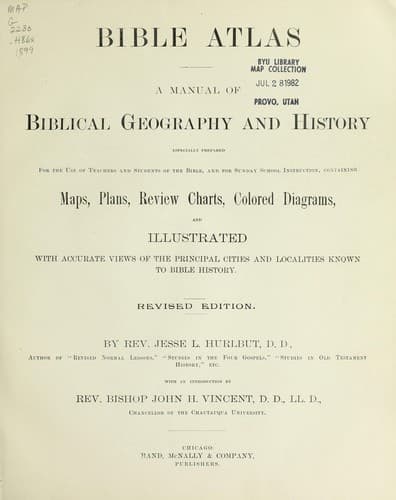
Bible Atlas: A Manual of Biblical Geography and HistoryHurlbut, Jesse Lyman
Religion
Bible Atlas: A Manual of Biblical Geography and History
Hurlbut, Jesse Lyman
Bible -- Geography; Bible -- Geography -- Maps; Bible -- History of Biblical events
5. The =Avim=, "ruins," or "dwellers in ruins," lived in the Shefelah,
or foot-hills, between the Philistine plain and the mountains of Judah.
(Deut. 2:23; Josh. 13:2, 3.) They were early conquered by the Caphtorim,
a Philistine race, and were in a depressed condition at the time of the
entrance of the Israelites. The word Hazerim (Deut. 2:23) means
"villages," or "nomad encampments," showing that they were not a
settled, but a wandering people.
6. The =Anakim=, "long-necked ones." The name may refer either to their
size, or their strength (which in Hebrew comes from a word similar to
_neck_). They were descendants of Arba, and divided into three clans,
named Sheshai, Ahiman and Talmai. (Josh. 14:15; 15:14.) Their principal
home was at Hebron, called by them Kirjath-arba; but they also occupied
a city near it, called Kirjath-sepher, or "book-town," a name which is
suggestive of a national literature. Unlike the other races, they seem
to have maintained a foothold in the presence of the incoming Canaanite
races, and their gigantic appearance struck terror to the Israelite
spies during the wandering. (Num. 13.) But they were conquered by Caleb
(Josh. 14), and their remnant, driven from the mountains, mingled with
the Philistines of the sea-coast plain. One family of this race remained
as late as the days of David, that of Goliath and his brothers. (1 Sam.
17:4; 2 Sam. 21:15-22.)
II. THE TRIBES OF THE PATRIARCHAL ERA.
The chosen family came to Palestine about 1921 B.C., according to the
common chronology, but probably from two to four hundred years earlier.
At this time these earliest races were already superseded in nearly all
the land by later tribes, of Hamitic origin, with which the patriarchs
were often brought into contact. Those tribes were often called
Canaanites, because the nation of that name was both the original stock
and in possession of the richest and best portion of the land.
We notice these tribes, as far as practicable, in the order of their
location in the four great natural divisions of the country: the tribes
of the maritime plain, those of the mountain region, those of the Jordan
Valley, and those of the eastern table-land.
1. Beginning at the north, on the narrow plain by the Mediterranean Sea,
we find the =Zidonians=, with their two great cities, Zidon the earlier,
and Tyre the later. Perhaps the latter city was not yet founded in the
patriarchal age. These people were early famous as the traders of the
Mediterranean world, having commercial relations as far as Spain. They
occupied a narrow strip of territory between Mount Lebanon and the sea,
north of Mount Carmel. Their country was never possessed by the
Israelites, and most of the time the relations between the two races
were peaceful.
Public-domain text, read in full here on John Shaqi.
Reviews
Reviews
No reviews yet
Be the first to share your thoughts on this work.
Elsewhere in the archive
Join the Discussion
Join the discussion
Sign in to leave a comment or review.
Sign InorCreate an account