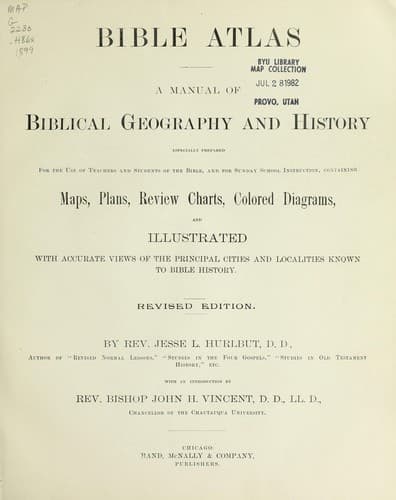
Bible Atlas: A Manual of Biblical Geography and HistoryHurlbut, Jesse Lyman
Religion
Bible Atlas: A Manual of Biblical Geography and History
Hurlbut, Jesse Lyman
Bible -- Geography; Bible -- Geography -- Maps; Bible -- History of Biblical events
4. We turn now to the tribes of the mountain region, beginning, as
before, at the north. As these northern regions are not alluded to in
patriarchal history, and only very briefly named in the annals of the
conquest, it is not easy to determine which of the tribes occupied them.
But, from allusions in Josh. 1:4 and 11:3, and from frequent mention on
the monuments of Egypt, we incline to the opinion that the =Hittites=
were the possessors of this country. They have left their name in
Hattin, the Caphar Hittai of the Talmud, near the Sea of Galilee.
Another branch, more frequently mentioned, were in the south, at and
around Hebron (Gen. 23), perhaps extending as far south as Beersheba.
(Gen. 27:46.) With these people the relations of the patriarchs were
ever peaceful, and of them Abraham purchased his family sepulchre.
[Illustration: HEBRON.]
5. The position of the =Girgashites= is uncertain, from the infrequent
mention of them. But the slight indications point to the region west of
the Sea of Galilee, where we locate them conjecturally. They may have
been absorbed by the surrounding tribes.
6. South of Mount Carmel, and extending to what was afterward the border
of Benjamin, we find the =Hivites=, having Shechem as their principal
city in the time of Jacob. (Gen. 34:2.) Afterward, they occupied several
towns immediately north of Jerusalem, four of which formed the
"Gibeonite league," and made a treaty of peace with Joshua. (Josh.
9:3-15.) They were a quiet people, averse to war, and submitting readily
to foreign domination.
7. The =Perizzites=, "villagers" are always named in connection with the
Canaanites. From the allusions in Gen. 34:30, Josh. 17:15, and other
places, we locate them between the Hivites and the western Canaanites,
in the northern portion of the Shefelah, or foot-hills, where villages
would more readily cluster than among the mountains. They remained in
the land as late as the time of the restoration from Babylonian
captivity. (Ezra 9:1.)
8. The =Jebusites= lived in the mountains around their city Jebus,
afterward Jerusalem. They were of Canaanitish origin, a small but
warlike tribe. Their king was slain by Joshua; but the city, though
burned by the Israelites (Judges 1:8), was still held by its own people,
and remained in their possession, a foreign fortress in the midst of the
land, until finally taken by David, and made his capital. (2 Sam. 5.)
South of the Jebusites were the southern branch of the Hittites, already
referred to.
Public-domain text, read in full here on John Shaqi.
Reviews
Reviews
No reviews yet
Be the first to share your thoughts on this work.
Elsewhere in the archive
Join the Discussion
Join the discussion
Sign in to leave a comment or review.
Sign InorCreate an account