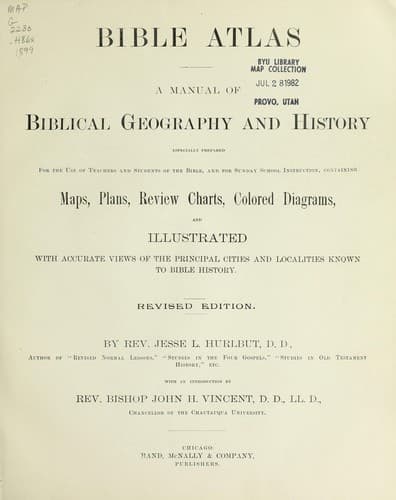
Bible Atlas: A Manual of Biblical Geography and HistoryHurlbut, Jesse Lyman
Religion
Bible Atlas: A Manual of Biblical Geography and History
Hurlbut, Jesse Lyman
Bible -- Geography; Bible -- Geography -- Maps; Bible -- History of Biblical events
2. Next in order of location we come to the =Canaanites= proper, or that
branch of the descendants of Canaan which retained the family name.
While _all_ the tribes of Palestine are often called Canaanites, as
descended from one stock, the name strictly belongs only to people who
lived in two sections of the country. The word means "lowlanders," and
was applied particularly to those dwelling on the maritime plain, on
both sides of Mount Carmel, the plain of Esdraelon and that of Sharon;
and to those in the Jordan Valley. These together constituted "the
Canaanites on the east and on the west." (Josh. 11:3.) They occupied the
richest and most valuable portions of the land. The only city on the
coast belonging to the Canaanites existing during the patriarchal age
was Joppa, still standing. The Canaanite cities in the Jordan Valley
were the "five cities of the plain," Sodom, Gomorrah, Admah, Zeboim and
Zoar, of which all except the last were destroyed by the visitation of
God. (Gen. 19.) Their location was in the plain on the north of the Dead
Sea, and there is no reason to suppose that they are covered by its
waters. In the time immediately before the conquest we find Jericho has
arisen in the place of the destroyed cities, and not far from their
site, as the most important city of the Jordan Valley.
3. South of the Canaanites, on the maritime plain, were the
=Philistines=. "Emigrants" is the meaning of the word, supporting the
view that they came from Caphtor, or Crete, which is but little more
than a surmise. They were related to the Egyptians, and hence were of
Hamitic stock. They came to the land before the time of Abraham, drove
out and subdued the earlier Avim (Deut. 2:23), or Avites, and had
frequent dealings with Abraham and Isaac. In the patriarchal age their
principal cities were Gaza and Gerar; but before the conquest they had
moved northward, and were a powerful confederacy of five cities: Gaza,
Ashkelon, Ashdod, Gath and Ekron. (Josh. 13:3.) Their territory, if
taken at all during the campaigns of Joshua, was soon reconquered, and
the Philistines were the most dangerous enemies of Israel during all the
period of the Judges. In David's time they were subjected; but not until
the Maccabean age were they fully conquered, and their land made a part
of Israel.
Public-domain text, read in full here on John Shaqi.
Reviews
Reviews
No reviews yet
Be the first to share your thoughts on this work.
Elsewhere in the archive
Join the Discussion
Join the discussion
Sign in to leave a comment or review.
Sign InorCreate an account