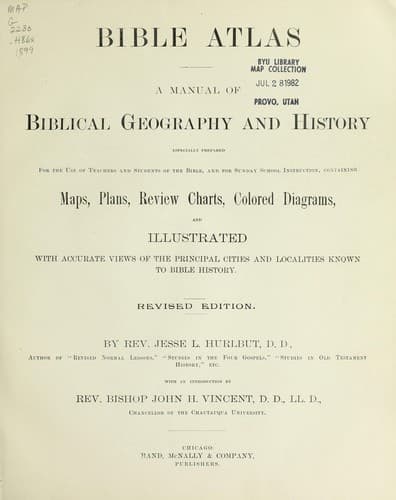
Bible Atlas: A Manual of Biblical Geography and HistoryHurlbut, Jesse Lyman
Religion
Bible Atlas: A Manual of Biblical Geography and History
Hurlbut, Jesse Lyman
Bible -- Geography; Bible -- Geography -- Maps; Bible -- History of Biblical events
IV. =The Nile.= This has been in every age the most important feature in
the topography of the country, and the cause of its surpassing
fertility. Its sources, long unknown, are in the great lakes of Central
Africa, whence it flows in a northerly direction. The main stream,
called the White Nile, receives in Nubia its principal tributary, the
Blue Nile, which rises in Abyssinia. During the last 1,500 miles of its
course it is not increased by any other stream, and flows through a
torrid desert. Yet, as it enters the Mediterranean, its current is still
that of a mighty river. Its mouths are at present three in number,
though formerly seven; and, from their resemblance on the map to the
Greek letter [Greek: D], that portion of Egypt is called the Delta. Its
annual overflow begins, in Lower Egypt, about the 25th of June, attains
its height in three months, and remains stationary twelve days, at a
height of about 36 feet above its ordinary level at Thebes, 25 feet at
Cairo, and 4 feet at its mouth. This overflow is due to the rains in
Central Africa, and as it brings down new soil, keeps the land always
fertile. But for the Nile, Egypt would only be a part of the Great
Desert.
V. =The People of Egypt= were of the Hamitic stock, a race of high
capacity, forming the earliest civilization known in history. They were
religious, but worshiping animals, and even the lowest forms of life;
contemplative and studious, attaining to considerable knowledge, though
on narrow lines of research; patriotic, but not fond of war, and
therefore rarely conquerors of other nations. Their language was
"agglutinative monosyllabic," with mingled Nigritic and Semitic
characteristics. Their government was most thoroughly organized, and
took cognizance of even the minute matters of life. Their art was
massive and sombre, imposing from its vastness, but not varied, and
therefore giving but little play to genius. The Egyptians were slender
of frame, but strong. Their faces were oval and olive-colored; their
hair long, crisp and jet-black. They are supposed to be represented at
the present time by the Copts.
[Illustration: AREA OF EGYPT.]
[Illustration: THE KINGDOM OF EGYPT AT ITS GREATEST EXTENT UNDER RAMESES
II.]
Public-domain text, read in full here on John Shaqi.
Reviews
Reviews
No reviews yet
Be the first to share your thoughts on this work.
Elsewhere in the archive
Join the Discussion
Join the discussion
Sign in to leave a comment or review.
Sign InorCreate an account