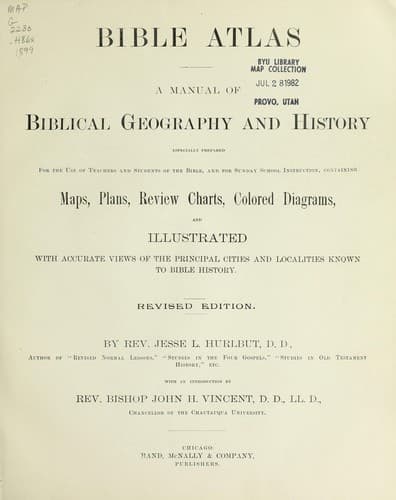
Bible Atlas: A Manual of Biblical Geography and HistoryHurlbut, Jesse Lyman
Religion
Bible Atlas: A Manual of Biblical Geography and History
Hurlbut, Jesse Lyman
Bible -- Geography; Bible -- Geography -- Maps; Bible -- History of Biblical events
VI. =The History of Egypt= begins at a time undated, but long after the
flood. It is divided into three periods, those of the Old, Middle, and
New Empires. The Old Empire was founded by Menes, and had its capital at
Memphis. During the fourth dynasty of this period the Pyramids were
built. The Middle Empire arose at Thebes, and lasted until 1570 B.C. The
Twelfth dynasty was most powerful during this epoch, conquering Ethiopia
and Arabia. About 2000 B.C. the land was conquered by foreign princes,
who ruled 400 years, and were known as the Hyksos, or Shepherd Kings.
The New Empire arose in 1570 B.C., after the expulsion of the Hyksos,
and lasted for a thousand years. Its greatest monarch was Rameses II.,
who has been supposed to be the "Pharaoh of the Oppression" (not of the
Exodus), and ruled as far east as Chaldea and Assyria. The above dates
are all uncertain. Concerning the chronology, see page 13. The land was
conquered by the Persians, B.C. 527, and annexed to the Persian empire.
VII. The principal =Places= were, in Lower Egypt, Memphis, the ancient
capital; Heliopolis, called in the Bible On, near the eastern branch of
the Delta; Rameses, in the Land of Goshen; Pelusium, at the eastern
mouth of the Nile; and Alexandria, in later history the metropolis of
Egypt, near the Canopic mouth of the Nile. In Upper Egypt, Thebes was
the most important place, and long the capital.
OUTLINE FOR REVIEW.
1. _Names._ Egypt, Kem, Mizraim, Rahab, Land of Ham.
2. _Boundaries and Dimensions._ North (Mediterranean Sea); East
(Palestine, Arabia, Red Sea); South (Nubia); West (African Desert).
Area, 115,000 square miles. Inhabitable, 9,600 square miles. Land, 5,600
square miles.
3. _Divisions._ Lower (Delta); Upper (Valley).
4. _Nile._ White Nile, Blue Nile; Sources; Delta; Overflow.
5. _People._ Hamitic Origin; Civilization; Language; Art; Physical
Traits.
6. _History._ Old Empire (Memphis, Pyramids); Middle Empire (Thebes,
Dynasty XII., Hyksos); New Empire (Rameses II., Persians).
THE WILDERNESS OF THE WANDERING.
I. =Situation.= This region lies between Egypt and Edom, a great
triangle, having for its three points the border of _Lake Menzaleh_, the
southern extremity of the Dead Sea, and _Ras Mohammed_, the southern end
of the peninsula. Its northern boundary is the Mediterranean Sea, the
land of the Philistines, and the _Negeb_, or South Country. Its
southeastern line is the depression of the _Arabah_, and the Gulf of
Akaba, or Ælanitic Gulf. Its southwestern line is the Isthmus of Suez
and the Gulf of Suez. From Egypt, in a line due east, to the Dead Sea,
is about 200 miles; from the Mediterranean, at the _Wady el Arish_ ("the
River of Egypt"), to Ras Mohammed, a line a little east of south, is
about 225 miles, thus making the entire area of the triangle about
22,500 square miles, or less than the aggregate area of New Hampshire,
Vermont and Massachusetts, though larger than any two of those States.
Public-domain text, read in full here on John Shaqi.
Reviews
Reviews
No reviews yet
Be the first to share your thoughts on this work.
Elsewhere in the archive
Join the Discussion
Join the discussion
Sign in to leave a comment or review.
Sign InorCreate an account