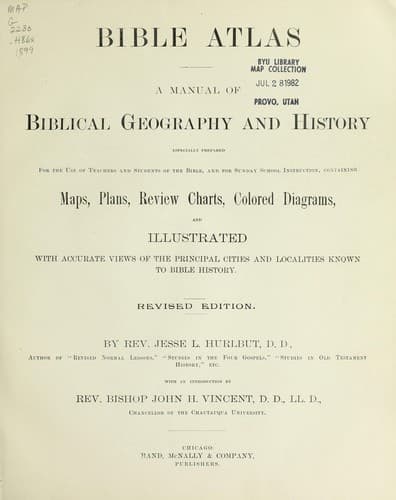
Bible Atlas: A Manual of Biblical Geography and HistoryHurlbut, Jesse Lyman
Religion
Bible Atlas: A Manual of Biblical Geography and History
Hurlbut, Jesse Lyman
Bible -- Geography; Bible -- Geography -- Maps; Bible -- History of Biblical events
3. =The Conquest of Northern Palestine.= (Josh. 11.) This region was
also occupied by a number of independent chiefs, of whom the most
powerful was Jabin, the king of Hazor, a title which afterward reappears
in the history. (Judges 4, 2.) They ruled over small tribes of various
races, from Mount Hermon to Mount Carmel, especially on the Plain of
Esdraelon. The king of Hazor called together the associated tribes, and
their camp was pitched near Lake Merom. Joshua made one of his
characteristic swift marches, up the Jordan Valley, attacked them
suddenly, and utterly defeated and scattered them. He burned the many
war chariots, and so cut the sinews of their horses as to make them
useless; since these animals were never used by the Israelites. After
the battle he marched through the northern regions, capturing the cities
and slaying their rulers, a number of whom are mentioned in the
catalogue of Josh. 12:9-24. This campaign closed the active operations,
so that "the land rested from war" (Josh. 11:23); but for many years the
strife was feebly continued, and it was not entirely finished until the
reign of David.
III. SUPPLEMENTARY CONQUESTS.
Although the struggle of the conquest was over, yet in most of the land
the task of expulsion or destruction was yet to be accomplished, and in
many places was never entirely wrought. The entire section of the
maritime plain remained in the hands of the Philistines; in almost every
tribe were fortresses, which long resisted the Israelites, and formed
centres of rebellion, and sometimes of oppression. And many of the
cities taken by Joshua were soon reoccupied by their original
inhabitants, and once more fortified. The book of the Judges relates
briefly three campaigns after the conquest.
1. =The Campaign of the Judaites and Simeonites.= (Judges 1:1-8.) This
was undertaken against Adoni-bezek, the king of Bezek, a place in or
near the tribe of Judah, not positively identified. Adoni-bezek was a
petty chieftain, who had cruelly mutilated no less than 70 local chiefs
whom he had taken in battle. He was surprised by the allied forces of
Judah and Simeon, and ten thousand of his warriors were slain. He was
taken prisoner, and treated as he had treated other captive kings; his
thumbs and great toes being cut off, thus making him helpless. After
this, the allied tribes marched down upon the maritime plain, and took
the Philistine cities of Gaza, Ashkelon and Ekron. But their conquests
were not permanent; they withdrew to the mountains, and the Philistines
were soon in possession of their cities, which long stood as a menace to
Israel. Another campaign was directed against the cities of the Negeb,
or South Country, and resulted in the destruction of Zephath and Hormah,
both south of Hebron.
Public-domain text, read in full here on John Shaqi.
Reviews
Reviews
No reviews yet
Be the first to share your thoughts on this work.
Elsewhere in the archive
Join the Discussion
Join the discussion
Sign in to leave a comment or review.
Sign InorCreate an account