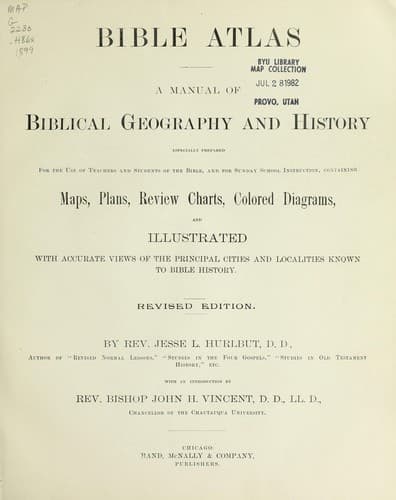
Bible Atlas: A Manual of Biblical Geography and HistoryHurlbut, Jesse Lyman
Religion
Bible Atlas: A Manual of Biblical Geography and History
Hurlbut, Jesse Lyman
Bible -- Geography; Bible -- Geography -- Maps; Bible -- History of Biblical events
2. =The Campaign of Caleb and Othniel.= Caleb was the oldest man in
Israel, having accompanied Joshua and the other spies, thirty-eight
years before the entrance of Israel into the Promised Land. (Num.
13-14.) For his faithfulness when so many were overcome with terror, he
received a promise of inheritance in the land. At least 45 years
afterward, Hebron, in the south of Judah, was allotted to him. It had
been taken by Joshua (Josh. 10:36, 37), but afterward reoccupied by the
Anakim (see page 38), and the Amorites, its original possessors. Caleb
led an army against it, once more won the city, and made it his own. He
promised his daughter, Achsah, to the warrior who should take Debir, or
Kirjath-sepher, south of Hebron, which had also been reoccupied by the
enemy. His younger brother (perhaps nephew) Othniel, won the city and
his bride. (Josh. 14:1-15; 15:13-19; Judges 1:10-15.) This campaign was
probably about the same time with the one narrated above, and may have
been in connection with it.
3. =The Danite Campaign.= (Judges 18.) The tribe of Dan found themselves
unable to overcome their Philistine neighbors, and were straitened for
room in their narrow possessions. They sent out a body of men to search
for a new home. These spies traversed the country as far to the north as
Laish, or Leshem, a Phoenician city, near one of the sources of the
Jordan. The Danite spies returned to their people at Zorah and Eshtaol,
and made their report. A part of the tribe agreed to migrate to this
northern region. Their first encampment on the journey, near
Kirjath-jearim, in Judah, long bore the name of "the camp of Dan." At a
village in Mount Ephraim they plundered Micah of his idols and carried
away their priest, who was a degenerate grandson of Moses the prophet.
At Laish they fell suddenly upon the defenseless Phoenicians, destroyed
their city, and built in its place one which they called Dan. It was the
northern landmark of the land, as Beersheba was its southern, giving
rise to the term "from Dan to Beersheba." Dan remained an idol
sanctuary, and a place of corrupting influence during all the after
history of Israel.
Public-domain text, read in full here on John Shaqi.
Reviews
Reviews
No reviews yet
Be the first to share your thoughts on this work.
Elsewhere in the archive
Join the Discussion
Join the discussion
Sign in to leave a comment or review.
Sign InorCreate an account