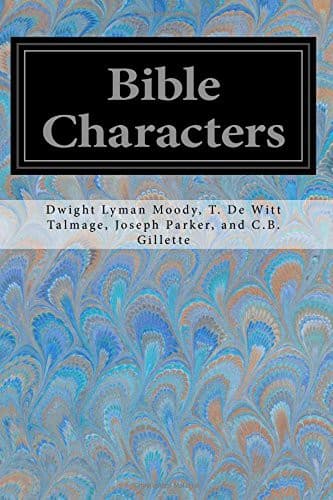
Bible CharactersTalmage, T. De Witt (Thomas De Witt)
Religion
Bible Characters
Talmage, T. De Witt (Thomas De Witt)
Bible -- Biography
The ship flies like chaff in the tornado. They drop the sounding line,
and by the light of the lantern they see it is twenty fathoms. Speeding
along a little farther, they drop the line again, and by the light of
the lantern they see it is fifteen fathoms. Two hundred and seventy-six
souls within a few feet of awful shipwreck!
The managers of the vessel, pretending they want to look over the side of
the ship and undergird it, get into the small boat, expecting in it to
escape; but Paul sees through the sham, and he tells them that if they go
off in the boat it will be the death of them.
The vessel strikes! The planks spring! The timbers crack! The vessel
parts in the thundering surge! Oh, what struggling for life! Here they
leap from plank to plank. There they go under as if they would never
rise, but, catching hold of a timber, they come floating and panting on
it to the beach.
Here strong swimmers spread their arms through the waves until their
chins plow the sand, and they rise up, and ring out their wet locks
on the beach. When the roll of the ship is called, two hundred and
seventy-six people answer to their names.
Paul was the most illustrious merely human being the world has ever
known. He walked the streets of Athens and preached from yonder pile of
rocks, Mars Hill.
Though more classic associations are connected with Athens than with
any other city under the sun--because here Socrates, Plato, Aristotle,
Demosthenes, Pericles, Herodotus, Pythagoras, Xenophon and Praxiteles
wrote, chiseled, taught, thundered or sung--yet, in my mind, all those
men and their teachings were eclipsed by Paul and the Gospel he preached
there and in the near-by city of Corinth. Standing yesterday on the old
fortress at Corinth, the Acro-Corinthus, out from the ruin at its base
arose in my imagination the old city--just as Paul saw it.
I have been told that, for splendor, the world beholds no such wonder
today as that ancient Corinth, standing on an isthmus washed by two
seas--the one sea bringing the commerce of Europe, the other sea bringing
the commerce of Asia.
From her wharves, in the construction of which entire kingdoms had been
absorbed, war galleys with three banks of oars pushed out and confounded
the navy yards of all the world.
Huge handed machinery, such as modern invention can not equal, lifted
ships from the sea on one side and transported them on trucks across the
isthmus and sat them down in the sea on the other side.
Public-domain text, read in full here on John Shaqi.
Reviews
Reviews
No reviews yet
Be the first to share your thoughts on this work.
Elsewhere in the archive
Join the Discussion
Join the discussion
Sign in to leave a comment or review.
Sign InorCreate an account