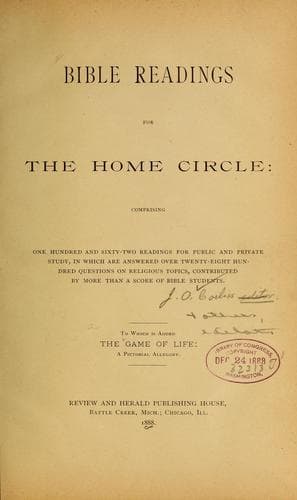
Bible -- Illustrations; Bible -- Indexes; Bible -- Study and teaching
“And the ten horns out of this kingdom are _ten kings that shall arise_.”
Verse 24.
NOTES.—The Roman Empire was broken up into ten kingdoms between
the years 351 A.D. and 476 A.D.
“The historian Machiavelli, without the slightest reference to
this prophecy, gives the following list of the nations which
occupied the territory of the Western Empire at the time of the
fall of Romulus Augustulus (476 A.D.), the last emperor of Rome:
The Lombards, the Franks, the Burgundians, the Ostrogoths, the
Visigoths, the Vandals, the Heruh, the Suevi, the Huns, and the
Saxons: ten in all.
“Amidst unceasing and almost countless fluctuations, the kingdoms
of modern Europe have from their birth to the present day
_averaged_ ten in number. They have never since the breaking up of
old Rome been united into one single empire; they have never
formed _one whole_ even like the United States. No scheme of proud
ambition seeking to reunite the broken fragments has ever
succeeded; when such have arisen, they have been invariably dashed
to pieces.
“And the division is as apparent now as ever. Plainly and palpably
inscribed on the map of Europe this day, it confronts the skeptic
with its silent but conclusive testimony to the fulfilment of this
great prophecy. Who can alter or add to this tenfold list of the
kingdoms now occupying the sphere of old Rome? _Italy, Austria,
Switzerland, France, Germany, England, Holland, Belgium, Spain,
and Portugal_—ten, and no more; ten, and no less.”—_“__The Divine
Program of the World’s History,__”__ by H. Grattan Guinness, pages
318-321._
15. What change did Daniel see take place in these horns?
“I considered the horns, and, behold, _there came up among them another
little horn, before whom there were three of the first horns plucked up by
the roots_: and, behold, in this horn were eyes like the eyes of man, and
a mouth speaking great things.” Verse 8.
16. What inquiry on the part of Daniel shows that the fourth beast, and
especially the little horn phase of it, constitutes the leading feature of
this vision?
“Then _I would know the truth of the fourth beast_, which was diverse from
all the others, exceeding dreadful, whose teeth were of iron, and his
nails of brass; which devoured, brake in pieces, and stamped the residue
with his feet; _and of the ten horns_ that were in his head, and _of the
other which came up_, and _before whom three fell_; even of that horn that
had eyes, and a mouth that spake very great things, whose look was more
stout than his fellows.” Verses 19, 20.
17. When was the little horn to arise?
“And another shall rise _after them_.” Verse 24.
NOTE.—The ten horns, as already shown, arose when Rome, the fourth
kingdom, was divided into ten kingdoms. This division was
completed in A.D. 476. The little-horn power was to arise after
them.
Public-domain text, read in full here on John Shaqi.
Reviews
Reviews
No reviews yet
Be the first to share your thoughts on this work.
Elsewhere in the archive
Join the Discussion
Join the discussion
Sign in to leave a comment or review.
Sign InorCreate an account