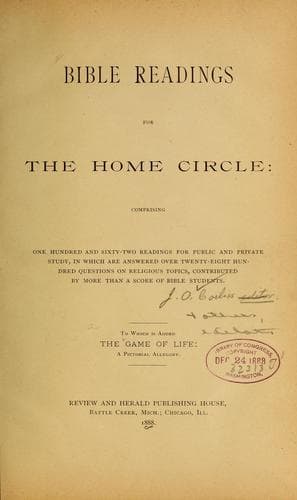
Bible -- Illustrations; Bible -- Indexes; Bible -- Study and teaching
18. What was to be the character of the little horn?
“And he shall be _diverse_ from the first, and he shall _subdue three
kings_.” Same verse, last part.
NOTES.—That power which arose in the Roman Empire after the fall
of Rome in A.D. 476, which was entirely different from all the ten
kingdoms into which Rome was divided (for it demanded and
exercised spiritual power over the other kingdoms), and before
whom three of the other kings—the Heruli, the Vandals, and the
Ostrogoths—fell, was the Papacy.
Having located the place and the time of the kingdom of the little
horn, the study of its character and work will be considered in
the readings which follow.
The Kingdom And Work Of Antichrist
[Illustration.]
The Papal Tiara. "He shall speak great words against the Most High." Dan.
7:25.
1. What is said of the little horn as compared with the ten horns of the
fourth beast of Daniel 7?
“He shall be _diverse_ from the first, and he shall subdue three kings.”
Dan. 7:24.
NOTE.—The Papacy, which arose on the ruins of the Roman Empire,
differed from all previous forms of Roman power, in that it was an
ecclesiastical despotism claiming universal dominion over both
spiritual and temporal affairs, especially the former. It was a
union of church and state, with the church dominant.
2. What attitude of rivalry was the Papacy, represented by the little
horn, to assume toward the Most High?
“And he shall _speak great words against the Most High_.” Verse 25, first
clause.
3. How does Paul, speaking of the man of sin, describe this same power?
“Who opposeth and exalteth himself above all that is called God, or that
is worshiped; so that he as God sitteth in the temple of God, showing
himself that he is God.” 2 Thess. 2:4.
NOTES.—The following extracts from authoritative works, most of
them by Roman Catholic writers, will indicate to what extent the
Papacy has done this:—
“All the names which are attributed to Christ in Scripture,
implying His supremacy over the church, are also attributed to the
Pope.”—_Bellarmine, __“__On the Authority of Councils__”__ book 2,
chap. 17._
“For thou art the shepherd, thou art the physician, thou art the
director, thou art the husbandman; finally thou art another God on
earth.”—_From Oration of Christopher Marcellus in fourth session
of Fifth Lateran Council, Labbe and Cossart’s __“__History of the
Councils,__”__ published in 1672, Vol. XIV, col. 109._
“For not man, but God, not by human but rather by divine
authority, releases those whom, on account of the need of the
churches or what is regarded as a benefit, the Roman pontiff (who
is vicegerent on earth, not of mere man, but of the true God)
separates [from their churches].”—_“__The Decretals of Gregory
IX,__”__ book 1, title 7, chap. 3._
Public-domain text, read in full here on John Shaqi.
Reviews
Reviews
No reviews yet
Be the first to share your thoughts on this work.
Elsewhere in the archive
Join the Discussion
Join the discussion
Sign in to leave a comment or review.
Sign InorCreate an account