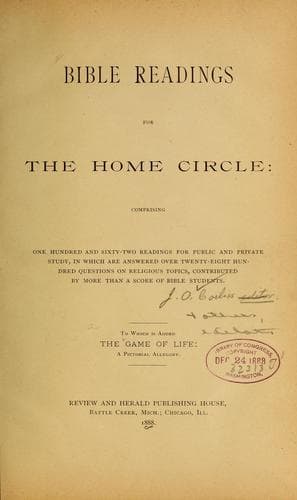
Bible -- Illustrations; Bible -- Indexes; Bible -- Study and teaching
“Therefore the he goat waxed very great: and when he was strong, _the
great horn was broken_; and for it came up four notable ones toward the
four winds of heaven.” Verse 8.
10. Who was represented by “the great horn,” and what followed when it was
broken?
“And the rough goat is the king [kingdom] of Grecia: and the great horn
that is between his eyes is _the first king_. Now that being broken,
whereas four stood up for it, _four kingdoms shall stand up out of the
nation_, but not in his power.” Verses 21, 22.
NOTES.—From the interpretation given, it is plain that the notable
“horn” upon the he goat represented Alexander the Great, who led
the Grecian forces in their conquest of Medo-Persia. Upon the
death of Alexander at Babylon, B.C. 323, there followed a brief
period of confusion in the struggle for the kingdom, but the
succession was definitely determined by the battle of Ipsus, B.C.
301. Alexander’s four leading generals—Cassander, Lysimachus,
Ptolemy, and Seleucus—became his successors.
“The vast empire created by Alexander’s unparalleled conquests was
distracted by the wranglings and wars of his successors, and
before the close of the fourth century before Christ, had become
broken up into many fragments. Besides minor states, four
well-defined and important monarchies rose out of the ruins....
Their rulers were Lysimachus, Cassander, Seleucus Nicator, and
Ptolemy, who had each assumed the title of king. The great horn
was broken; and instead of it came up four notable ones toward the
four winds of heaven.”—_Myers’s __“__History of Greece,__”__ page
457, edition 1902._
11. What came out of one of the four horns of the goat?
“And out of one of them came forth a _little horn_, which waxed _exceeding
great_, toward the south, and toward the east, and toward the pleasant
land.” Verse 9.
12. What interpretation is given to this little horn?
“And in the latter time of their kingdom, when the transgressors are come
to the full, _a king of fierce countenance, and understanding dark
sentences, shall stand up_.” Verse 23.
13. What did this little horn do to the people of God?
“And it waxed great, even to the host of heaven; and _it cast down some of
the host and of the stars to the ground, and stamped upon them_.” Verse
10.
14. In what literal language is this persecution of the people of God
further described?
“And his power shall be mighty, but not by his own power: and he shall
destroy wonderfully, and shall prosper, and practise, and shall destroy
the mighty and the holy people.” Verse 24.
15. How was this little horn to exalt itself against Christ and His
mediatorial work?
“Yea, it magnified itself, even to the Prince of the host, and _it took
away from Him the continual burnt offering_, and the place of His
sanctuary was cast down.” Verse 11, R. V.
16. In the interpretation of the vision, how is this self-exaltation set
forth?
Public-domain text, read in full here on John Shaqi.
Reviews
Reviews
No reviews yet
Be the first to share your thoughts on this work.
Elsewhere in the archive
Join the Discussion
Join the discussion
Sign in to leave a comment or review.
Sign InorCreate an account