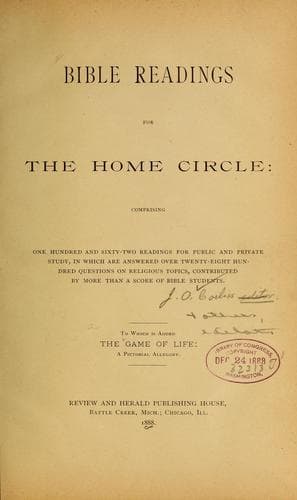
Bible -- Illustrations; Bible -- Indexes; Bible -- Study and teaching
“And through his policy also he shall cause craft to prosper in his hand;
and _he shall magnify himself in his heart_, and by peace shall destroy
many: _he shall also stand up against the Prince of princes_; but he shall
be broken without hand.” Verse 25.
17. What similar language is used by the apostle Paul in describing the
“mystery of iniquity,” or “man of sin”?
“That day shall not come, except there come a falling away first, and that
man of sin be revealed, the son of perdition; _who opposeth and exalteth
himself above all that is called God, or that is worshiped; so that he as
God sitteth in the temple of God, showing himself that he is God_.” 2
Thess. 2:3, 4.
NOTE.—The last two scriptures evidently describe one and the same
power,—a power which, while religious and professedly Christian,
is anti-christian in spirit, and the very “man of sin” himself.
Possessed with the selfish ambition of Lucifer (Isa. 14:12-14;
Eze. 28:17), he assumes to occupy the very seat and place of Deity
in the temple of God. Professing to be Christ’s vicar, or personal
representative on earth, he magnifies himself against Christ, and
“stands up,” or reigns, in the place of, and “against,” the Prince
of princes.
18. What was given into the hands of the power represented by the little
horn?
“And _the host_ was given over to it together with _the continual burnt
offering_ through transgression.” Dan. 8:12, first clause, R. V.
19. What did this power do to the truth?
“And _it cast down truth to the ground_, and it did its pleasure and
prospered.” Same verse, last clause, R. V.
NOTES.—The interpretation already given to this vision shows
plainly that the power represented by the little horn is the
successor of Medo-Persia and Grecia. In the vision of the seventh
chapter of Daniel, which is closely related to this vision, the
fourth beast represented the fourth kingdom, or Rome, in its
entirety, special attention, however, being given to the “little
horn” phase of its history. As shown by the work attributed to it,
this little horn, which arose among the ten kingdoms into which
Rome was divided, was to be a religio-political power, which was
to change the times and law of God, and persecute the people of
God. In the vision of the eighth chapter the ecclesiastical
features of this fourth world power are especially noticed and
emphasized, and hence the only symbol there used to represent it
is the “little horn” which waxed “exceeding great.”
Public-domain text, read in full here on John Shaqi.
Reviews
Reviews
No reviews yet
Be the first to share your thoughts on this work.
Elsewhere in the archive
Join the Discussion
Join the discussion
Sign in to leave a comment or review.
Sign InorCreate an account