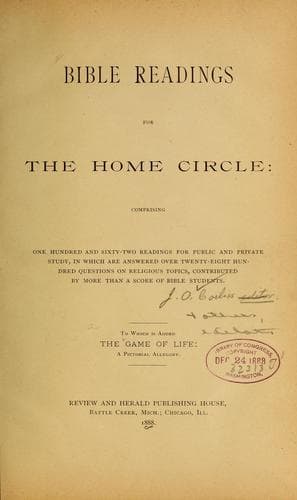
Bible -- Illustrations; Bible -- Indexes; Bible -- Study and teaching
“The first angel sounded, and there followed _hail_ and _fire_ mingled
with _blood_, and they were cast upon the earth: and the third part of
trees was burnt up, and all green grass was burnt up.” Rev. 8:7.
NOTES.—“Twice, at least, before the Roman Empire became divided
permanently into the two parts, the Eastern and the Western, there
was a tripartite division of the empire. The first occurred 311
A.D., when it was divided between Constantine, Licinius, and
Maximin; the other, 337 A.D., on the death of Constantine, when it
was divided between his three sons, Constantine, Constans, and
Constantius.”—_Albert Barnes, on Rev. 12:4._ To Constantius was
given Constantinople and the East; to Constans, Italy, Illyricum,
and northern Africa; and to Constantine II, Britain, Gaul, and
Spain.
This trumpet describes the first great invasion upon Western or
ancient Rome, by the Goths, under Alaric, from 395 A.D. to 410
A.D. In 408 he descended upon Italy, the middle “third part,”
pillaging and burning cities, and slaughtering their inhabitants.
Says Gibbon, in his “Decline and Fall of the Roman Empire,”
chapter 33, closing sentence, “The union of the Roman Empire was
dissolved; its genius was humbled in the dust; and armies of
unknown barbarians, issuing from the frozen regions of the North,
had established their victorious reign over the fairest provinces
of Europe and Africa.”
4. What striking figure is used to describe the destruction wrought under
the second trumpet?
“And the second angel sounded, and as it were _a great mountain burning
with fire was cast into the sea_: and the third part of the sea became
blood; and the third part of the creatures which were in the sea, and had
life, died; and the third part of the ships were destroyed.” Verses 8, 9.
NOTE.—This describes the invasions and conquests of the Vandals
under the terrible Genseric—first of Africa and later of
Italy—from 428 to 476 A.D. His conquests were largely by sea. In a
single night, near Carthage, he destroyed, by fire and sword, more
than half of the Roman fleet, consisting of 1,113 ships and over
100,000 men. See Gibbon’s “Decline and Fall of the Roman Empire,”
chapter 36.
5. What was to take place under the third trumpet?
“And the third angel sounded, and _there fell a great star from heaven,
burning as it were a lamp_, and it fell upon the third part of the rivers,
and upon the fountains of waters; and the name of the star is called
_Wormwood_: and the third part of the waters became wormwood; _and many
men died of the waters_, because they were made bitter.” Verses 10, 11.
Public-domain text, read in full here on John Shaqi.
Reviews
Reviews
No reviews yet
Be the first to share your thoughts on this work.
Elsewhere in the archive
Join the Discussion
Join the discussion
Sign in to leave a comment or review.
Sign InorCreate an account