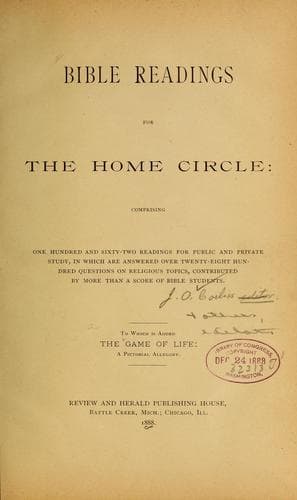
Bible -- Illustrations; Bible -- Indexes; Bible -- Study and teaching
NOTES.—The harassing invasions and conquests of Attila, the Hun,
are foretold here. His conquests were characterized by fire;
sword, and pillage along the Rhine, in Gaul, and northern Italy.
He claimed descent from Nimrod, styled himself the “Scourge of
God” and the “Dread of the World,” and boasted that grass would
never grow again where his horse had trod. His greatest battle was
at Chalons, in Gaul, 451 A.D., where of his 700,000 men from
100,000 to 300,000 are said to have been left dead on the field.
See Gibbon’s Rome, chapter 35, and “Fifteen Decisive Battles of
the World,” by Sir Edward Creasy, chapter 6.
Says Gibbon (chapter 34), “In the reign of Attila, the Huns again
became the terror of the world;” and he proceeds to describe “the
character and actions of that formidable barbarian, who,” he says,
“alternately insulted and invaded the East and the West, and urged
the rapid downfall of the Roman Empire.”
6. What was to occur under the fourth trumpet?
“And the fourth angel sounded, and _the third part of the sun was smitten,
and the third part of the moon, and the third part of the stars_; so as
the third part of them was darkened, and the day shone not for a third
part of it, and the night likewise.” Verse 12.
NOTE.—This trumpet brings us to the fall of Western Rome, in 476
A.D., when the Herulian barbarians, under the leadership of
Odoacer, took possession of the city and scepter of Rome; and the
great empire which had hitherto been the empress of the world was
reduced to a poor dukedom, tributary to the exarch of Ravenna. Its
luminaries, or civil rulers, were smitten, and ceased to shine.
“Italy now became in effect a province of the empire of the East.
The Roman Empire in the West had come to an end, after an
existence from the founding of Rome of 1,229 years.”—_Myers’s
__“__General History,__”__ page 348._
7. What was to be the character of the last three trumpets?
“And I beheld, and heard an angel flying through the midst of heaven,
saying with a loud voice, _Woe, woe, woe_, to the inhabiters of the earth
by reason of the other voices of the trumpet of the three angels, which
are yet to sound!” Verse 13.
[Illustration.]
The Seven Trumpets.
8. After the fall of Western Rome, what power in the East arose to harass
and overrun the Roman world, East and West?
Mohammedanism, commonly known as the Turkish or Ottoman power, which arose
in Arabia, with Mohammed, in 622 A.D.
9. How is the fifth trumpet, or first woe, introduced?
Public-domain text, read in full here on John Shaqi.
Reviews
Reviews
No reviews yet
Be the first to share your thoughts on this work.
Elsewhere in the archive
Join the Discussion
Join the discussion
Sign in to leave a comment or review.
Sign InorCreate an account