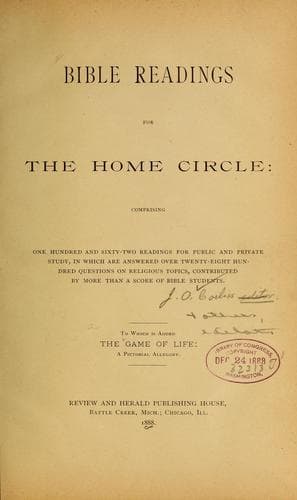
Bible -- Illustrations; Bible -- Indexes; Bible -- Study and teaching
“Thou shalt love the Lord thy God with all thy heart, and with all thy
soul, and with all thy mind. This is the first and great commandment. And
the second is like unto it, Thou shalt love thy neighbor as thyself. On
these two commandments hang all the law and the prophets.” Matt. 22:37-40.
NOTE.—“Does any man say to me, ‘You see, then, instead of the ten
commandments, we have received the two commandments, and these are
much easier’? I answer that this reading of the law is not in the
least easier. Such a remark implies a want of thought and
experience. Those two precepts comprehend the ten at their fullest
extent, and cannot be regarded as the erasure of a jot or tittle
of them. Whatever difficulties surround the commands are equally
found in the two, which are their sum and substance. If you love
God with all your heart, you must keep the first table; and if you
love your neighbor as yourself, you must keep the second
table.”—_“__The Perpetuity of the Law of God,__”__ by C. H.
Spurgeon, page 6._
34. What is said of one who professes to know the Lord, but does not keep
His commandments?
“He that saith, I know Him, and keepeth not His commandments, is _a liar_,
and _the truth is not in him_.” 1 John 2:4.
35. What promise is made to the willing and obedient?
“If ye be willing and obedient, _ye shall eat the good of the land_.” Isa.
1:19.
36. How does God regard those who walk in His law?
“_Blessed_ are the undefiled in the way, who walk in the law of the Lord.”
Ps. 119:1.
Perpetuity Of The Law
[Illustration.]
Christ Expounding The Law. "Think not that I am come to destroy the law,
or the prophets." Matt. 5:17.
1. How many lawgivers are there?
“There is _one lawgiver_, who is able to save and to destroy.” James 4:12.
2. What is said of the stability of God’s character?
“For I am the Lord, _I change not_.” Mal. 3:6.
3. How enduring are His commandments?
“The works of His hands are verity and judgment; _all His commandments are
sure. They stand fast forever and ever_, and are done in truth and
uprightness.” Ps. 111:7, 8.
4. Did Christ come to abolish or to destroy the law?
“Think not that I am come to destroy the law, or the prophets: _I am not
come to destroy, but to fulfil_.” Matt. 5:17.
NOTES.—_The law_; broadly, the writings of Moses; specifically,
the ten commandments, or moral law, from which the writings of
Moses primarily derived their name. _The prophets_; that is, the
writings of the prophets. Neither of these Christ came to destroy,
but rather to fulfil, or meet their design.
Public-domain text, read in full here on John Shaqi.
Reviews
Reviews
No reviews yet
Be the first to share your thoughts on this work.
Elsewhere in the archive
Join the Discussion
Join the discussion
Sign in to leave a comment or review.
Sign InorCreate an account