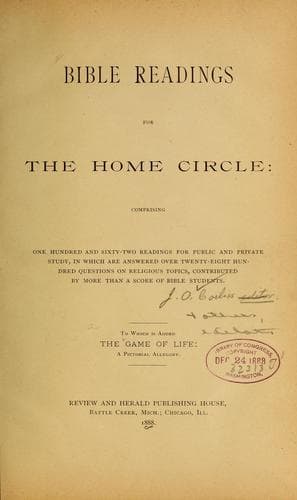
Bible -- Illustrations; Bible -- Indexes; Bible -- Study and teaching
“The laws of the Jews are commonly divided into moral, ceremonial,
and judicial. The moral laws are such as grow out of the nature of
things, which cannot, therefore, be changed,—such as the duty of
loving God and His creatures. These cannot be abolished, as it can
never be made right to hate God, or to hate our fellow men. Of
this kind are the ten commandments; and these our Saviour neither
abolished nor superseded. The ceremonial laws are such as are
appointed to meet certain states of society, or to regulate the
religious rites and ceremonies of a people. These can be changed
when circumstances are changed, and yet the moral law be
untouched.”—_Dr. Albert Barnes, on Matt. 5:18._
“Jesus did not come to change the law, but He came to explain it,
and that very fact shows that it remains; for there is no need to
explain that which is abrogated.... By thus explaining the law He
confirmed it; He could not have meant to abolish it, or He would
not have needed to expound it.... That the Master did not come to
alter the law is clear, because after having embodied it in His
life, He willingly gave Himself up to bear its penalty, though He
had never broken it, bearing the penalty for us, even as it is
written, ‘Christ hath redeemed us from the curse of the law, being
made a curse for us.’ ... If the law had demanded more of us than
it ought to have done, would the Lord Jesus have rendered to it
the penalty which resulted from its too severe demands? I am sure
He would not. But because the law asked only what it ought to ask,
namely, perfect obedience, and exacted of the transgressor only
what it ought to exact, namely, death as the penalty for
sin,—death under divine wrath,—therefore the Saviour went to the
tree, and there bore our sins, and purged them once for
all.”—_“__The Perpetuity of the Law of God,__”__ by C. H.
Spurgeon, pages 4-7._
“The moral law contained in the ten commandments, and enforced by
the prophets, He did not take away. It was not the design of His
coming to revoke any part of this.... Every part of this law must
remain in force upon all mankind and in all ages, as not depending
either on time or place, or any other circumstance liable to
change, but on the nature of God, and the nature of man, and their
unchangeable relation to each other.”—_John Wesley, in his
__“__Sermons,__”__ Vol. I, No. 25, pages 221, 222._
5. When used with reference to prophecy, what does the word _fulfil_ mean?
To fill up; to accomplish; to bring to pass; as, “that it might be
_fulfilled_ which was spoken by Esaias the prophet.” Matt. 4:14.
6. What does it mean when used with reference to law?
To perform, to keep, or to act in accordance with; as, “Bear ye one
another’s burdens, and so _fulfil_ the law of Christ.” Gal. 6:2. See also
Matt. 3:15; James 2:8, 9.
Public-domain text, read in full here on John Shaqi.
Reviews
Reviews
No reviews yet
Be the first to share your thoughts on this work.
Elsewhere in the archive
Join the Discussion
Join the discussion
Sign in to leave a comment or review.
Sign InorCreate an account