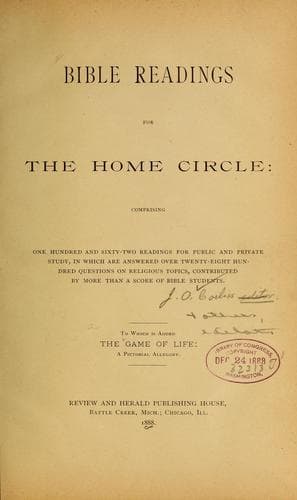
Bible -- Illustrations; Bible -- Indexes; Bible -- Study and teaching
7. How did Christ treat His Father’s commandments?
“I have _kept_ My Father’s commandments, and abide in His love.” John
15:10.
8. If one professes to abide in Christ, how ought he to walk?
“He that saith he abideth in Him _ought himself also so to walk, even as
He walked_.” 1 John 2:6.
9. What is sin?
“Whosoever committeth sin transgresseth also the law: for _sin is the
transgression of the law_.” 1 John 3:4.
NOTE.—This text does not say that sin _was_ the transgression of
the law, but that it _is_ this, thus demonstrating that the law is
still in force in the gospel dispensation. “Whosoever” likewise
shows the universality of its binding claims. Whoever of any
nation, race, or people commits sin, transgresses the law.
[Illustration.]
The Great Sacrifice. "Do we then make void the law through faith? God
forbid: yea, we establish the law." Rom. 3:31.
10. In what condition are all men?
“For _all have sinned_, and come short of the glory of God.” Rom. 3:23.
11. How many are included in the “all” who have sinned?
“What then? are we better than they? No, in no wise: for we have before
proved _both Jews and Gentiles_, that _they are all under sin_.” Verse 9.
12. By what are all men proved guilty?
“Now we know that _what things soever the law saith_, it saith to them who
are under the law: _that every mouth may be stopped, and all the world may
become guilty before God_.” Verse 19.
NOTE.—It is what the law says, and not what one may interpret it
to mean, that proves the sinner guilty. Moreover, God is no
respecter of persons, but treats Jew and Gentile alike. Measured
by the law, _all the world_ are guilty before God.
13. Does faith in God make void the law?
“Do we then make void the law through faith? _God forbid: yea, we
establish the law_.” Verse 31.
14. What, more than all else, proves the perpetuity and immutability of
the law of God?
“For _God so loved the world, that He gave His only begotten Son_, that
whosoever believeth in Him should not perish, but have everlasting life.”
John 3:16. “Christ died for our sins.” 1 Cor. 15:3.
NOTE.—Could the law have been abolished, and sin been disposed of
in this way, Christ need not have come and died for our sins. The
gift of Christ, therefore, more than all else, proves the
immutability of the law of God. Christ must come and die, and
satisfy the claims of the law, or the world must perish. The law
could not give way. Says Spurgeon in his sermon on “The Perpetuity
of the Law of God,” “Our Lord Jesus Christ gave a greater
vindication of the law by dying because it had been broken than
all the lost can ever give by their miseries.” The fact that the
law is to be the standard in the judgment is another proof of its
enduring nature. See Eccl. 12:13, 14; James 2:8-12.
15. What relation does a justified person sustain to the law?
Public-domain text, read in full here on John Shaqi.
Reviews
Reviews
No reviews yet
Be the first to share your thoughts on this work.
Elsewhere in the archive
Join the Discussion
Join the discussion
Sign in to leave a comment or review.
Sign InorCreate an account