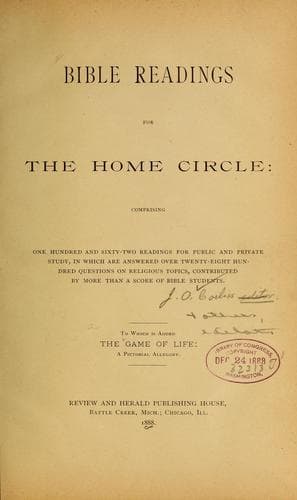
Bible -- Illustrations; Bible -- Indexes; Bible -- Study and teaching
NOTE.—The new covenant is an arrangement for bringing man again
into harmony with the divine will, and placing him where he can
keep God’s law. Its “better promises” bring forgiveness of sins,
grace to renew the heart, and power to obey the law of God. The
dissolution of the old covenant and the making of the new in no
wise abrogated the law of God.
28. Where was the law of God written under the old covenant?
“And I made an ark of shittim-wood, and hewed _two tables of stone.... And
He wrote on the tables ... the ten commandments_, which the Lord spake
unto you in the mount out of the midst of the fire in the day of the
assembly: and the Lord gave them unto me.” Deut. 10:3, 4.
29. Where is the law of God written under the new covenant?
“But this shall be the covenant that I will make with the house of Israel;
After those days, saith the Lord, _I will put My law in their inward
parts, and write it in their hearts_.” Jer. 31:33.
30. What reason is given for making the new covenant?
“For if that first covenant had been _faultless_, then should no place
have been sought for the second. For _finding fault with them_, he saith,
Behold, the days come, saith the Lord, when I will make a new covenant.”
Heb. 8:7, 8.
NOTE.—The chief fault in connection with the old covenant lay with
_the people_. They were not able, in themselves, to fulfil their
part of it, and it provided them no help for so doing. There was
no Christ in it. It was of _works_ and not of _grace_. It was
valuable only as a means of impressing upon them their sinfulness
and their need of divine aid.
31. What unites all believers under the new covenant?
“Wherefore remember, that ye being in time past Gentiles in the flesh, who
are called Uncircumcision by that which is called the Circumcision in the
flesh made by hands; that at that time ye were without Christ, being
aliens from the commonwealth of Israel, and strangers from the covenants
of promise, having no hope, and without God in the world: _but now in
Christ Jesus ye who sometimes were far off are made nigh by the blood of
Christ_.” Eph. 2:11-13.
Similarities Between The Two Covenants
1. Both are called covenants.
2. Both were ratified with blood.
3. Both were made concerning the law of God.
4. Both were made with the people of God.
5. Both were established upon promises.
Dissimilarities Between The Two Covenants
Public-domain text, read in full here on John Shaqi.
Reviews
Reviews
No reviews yet
Be the first to share your thoughts on this work.
Elsewhere in the archive
Join the Discussion
Join the discussion
Sign in to leave a comment or review.
Sign InorCreate an account